








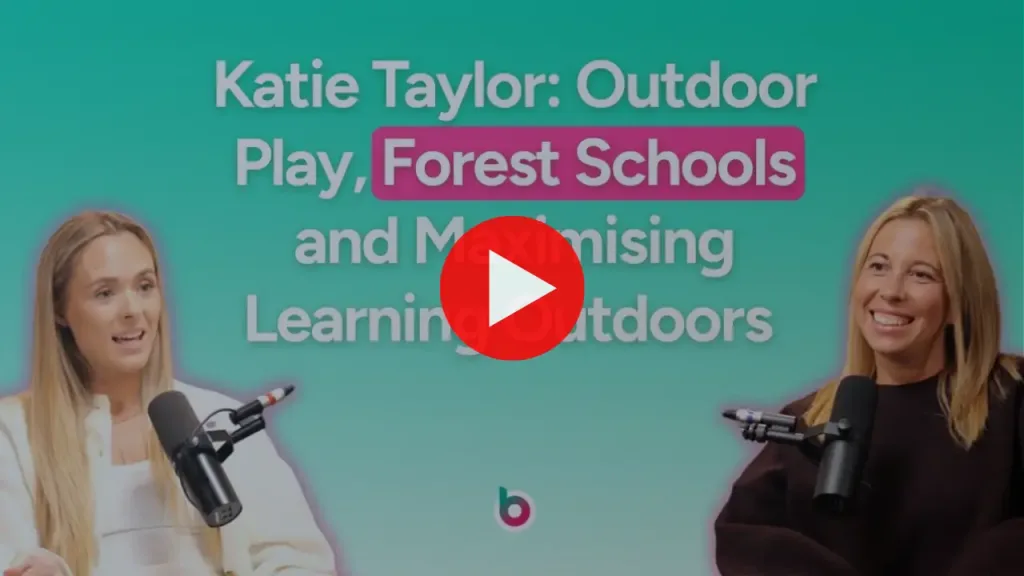
In the fourth episode of Season 2 of the Early Bloom Podcast, we welcomed Katie Taylor, an EYFS teacher and consultant, forest school leader, and founder of Early Years Outdoor.
Katie is also the author of ‘The Nature Adventure Book’ and a passionate advocate for outdoor learning in the early years.
During our conversation we cover:
- Barriers educators face when it comes to outdoor play, and how to overcome them
- How to make the most out of your outdoor space, even when budget is tight
- Forest school principles and how to become a forest school leader
- Balancing screen time with outdoor play for healthy development
For the impact of outdoor learning and play on send, check out our podcast on that very topic!
Transcript (Generated with AI)
00:00:01 Fliss Welcome back.
00:00:02 Fliss I’m Fliss, your host of Early Bloom, the podcast where we’re creating connections between everyone in the early years, coming up in this episode.
00:00:11 Katie I think that sometimes the staffing ratios will also have a big impact on being able to get outdoors if you’ve only got a couple of members of staff indoors.
00:00:21 Katie and you’re dealing with lots of things inside.
00:00:24 Katie Obviously we know how hard it is in early years that a child could have an accident or you’ve got lots of things to deliver throughout the day that actually sometimes the outdoors can be seen as Not as.
00:00:35 Katie is important and we just kind of need to prioritise that I think a little bit more sometimes.
00:00:40 Katie If we look at the outside environment as we do the inside and put as much sort of ownership onto making it a lovely space that the children can go outside into and really plan that space as we do the inside, so we’re planning our role plays and the sand and the water and things inside, but thinking actually what can I put outside that the children will get the most from?
00:01:01 Katie I think when I first went into it I thought oh I’ll just be able to go and do some sort of School sessions, but actually it’s really hard going to get the forest school leader qualification, but once you do it, changes that sort of mindset and how you approach things.
00:01:20 Fliss Hello and thanks for tuning in to another episode of the Early Bloom Podcast.
00:01:23 Fliss For today’s conversation, we’re welcoming Katie Taylor.
00:01:26 Fliss Katie is a teacher, a EY First consultant and a forest school leader.
00:01:32 Fliss You may also know her as the founder of Early Years Outdoor and the author of The Nature Adventure book.
00:01:39 Fliss Yes.
00:01:39 Fliss Got that right.
00:01:40 Fliss Katie, welcome to the podcast.
00:01:42 Katie Thank you, lovely to be here.
00:01:43 Fliss Oh, it’s lovely to have you on.
00:01:44 Fliss So let’s start by getting to know you a little bit more and your journey to where you are today with Early Years Outdoor.
00:01:50 Katie Yeah, well I started teaching in 2007, so I did my teaching degree in early years at Sheffield Hallam.
00:01:58 Katie And then since then I’ve been a reception teacher and EYFS leader and I did that for 17 years.
00:02:08 Katie At the same time when I was teaching I went into my forest school leader qualification and that just sort of transformed the way that I taught and changed everything about how I approach things really.
00:02:21 Katie So it ignited a passion for outdoor learning and then
00:02:25 Katie I set up my Instagram and just started sharing ideas and outdoor learning things with other educators and I got quite a big following on social media.
00:02:36 Katie And from there I went on to write my first book, which was the Nature Adventure book because it was all about the things that I’d sort of been sharing online.
00:02:45 Katie I’m writing my second book now.
00:02:47 Katie Oh, it’s exciting.
00:02:48 Katie Yeah, that one is all about mud kitchens and lots of lovely activities.
00:02:53 Katie To do with mud kitchens, so I’m doing that currently, and that’s around next year, and I’ve just been creating lots of activity ideas online and things like that, so…
00:03:04 Katie So lots of things really, really busy.
00:03:06 Katie So I’ve been out of the classroom since September last year, mainly focusing on my website, doing some consultancy work.
00:03:13 Katie So I’ve been really busy and still living it and I’ve done a little bit of supply work as well.
00:03:18 Fliss Still keeping in touch with the classroom.
00:03:20 Fliss Hard to leave it fully, isn’t it?
00:03:21 Katie Yeah, it is.
00:03:22 Katie And I do miss that sort of having my own class and seeing the children every day, but it’s been it’s been great.
00:03:28 Fliss Oh, nice.
00:03:29 Fliss And I guess with outdoor learning and stuff, and that’s a lot of what your resources are about.
00:03:34 Fliss And we know how beneficial outdoor play is for children and the opportunities that it brings, but many settings you do find you see it quite a lot.
00:03:42 Fliss They have a few barriers and a few challenges to getting outside and making the most of their outdoor space.
00:03:48 Fliss What are some of the things that you’ve seen?
00:03:50 Katie I think that right now the curriculum is really full.
00:03:54 Katie There’s lots of pressure on educators to deliver lots of things throughout the day.
00:03:58 Katie It could be phonics, it could be maths side of things or whether they’ve just got so many things packed into their day that actually outdoor learning can be seen as an add-on or let’s go outside to just get some fresh air and really we just sort of need to get introduced that so that it’s there all the time and we’re making the most of the outdoor environment.
00:04:19 Katie I think that sometimes the staffing ratios will also have a big impact on being able to get outdoors if you’ve only got a couple of members of staff indoors and you’re dealing with lots of things inside.
00:04:32 Katie Obviously we know how hard it is in early years.
00:04:34 Katie A child could have an accident or you’ve got lots of things to deliver throughout the day that actually sometimes the outdoors can be seen as not as important and we just kind of need to prioritise that I think a little bit more sometimes.
00:04:48 Katie So just putting that sort of ownership onto educators being able to go outside and deliver their sessions outside.
00:04:56 Katie So if you’re doing something around a maths activity or any kind of activities, it can be done outside and making sure that we get outdoors as much as possible.
00:05:05 Katie So yeah, I think lots of things are a sort of barrier to outdooring.
00:05:10 Katie It could be the weather,
00:05:11 Katie It could be that you’ve not got a great budget for your outdoor environment, and it’s looking at ways to utilise recycled materials, the natural seasons, and using all of those outdoors as well.
00:05:24 Katie So there’s lots of barriers, but lots of ways to overcome those.
00:05:28 Fliss Yeah, definitely.
00:05:28 Fliss And I always think with the outdoor area on a budget, that’s something that you see loads.
00:05:32 Fliss I’m going to say a lot on the Facebook groups, you’re always asking people.
00:05:35 Fliss How do I like improve my outdoor area on a budget and all them things like going to charity shops, the things like pallets, the things that you can do with pallets, tyres, those sort of things.
00:05:43 Fliss And it’s just making people aware that like it doesn’t have to be a whole new fancy playground equipment.
00:05:48 Fliss You can like create a really great outdoor environment with really cheap resources and the weather as well.
00:05:54 Fliss That’s another thing, isn’t it?
00:05:54 Fliss What’s that quote?
00:05:55 Fliss It’s no such thing.
00:05:56 Katie No such thing as bad weather, it’s just inappropriate clothing.
00:05:59 Fliss Inappropriate clothing.
00:06:00 Fliss Yeah, that should be just like plastered over every earlier setting just to remind everyone and parents as well.
00:06:05 Fliss the right clothing, children can go outside and have so much fun.
00:06:09 Fliss Yeah, I love that.
00:06:10 Katie I think with the weather side of things, obviously if you’ve got the right kit on, then it’s perfect for your outdoor play and your outdoor learning because if they’re happy, then obviously they can get engaged and they can get outdoors as much as possible and embrace the weather.
00:06:25 Katie If it’s raining, then let’s change sort of that mindset of what we as educators are saying instead of saying, oh no, it’s raining outside instead.
00:06:34 Katie yes, let’s go outside, we can get the umbrellas up, we can splash in the puddles and just thinking of that sort of language that we use around children so that they’re not saying, I don’t want to go outside because I’m going to get wet and seeing it as a really exciting opportunity.
00:06:48 Katie Even windy days and things like that and just bringing things in like making ribbon sticks and waving those and going outside and embracing the weather I think when it’s cold and windy they can
00:07:02 Katie freeze things and just use the weather to its advantage.
00:07:07 Fliss Embrace the seasons and bring that into the play in the language that you use and stuff.
00:07:11 Fliss I think that’s a really good tip.
00:07:13 Fliss And I guess as well, for those that have not got a great outdoor environment, so maybe like some nurseries have only got a little bit of concrete or whatever, or they’ve not, they can’t really offer a free flow or anything like that, how can they make the most out of that environment?
00:07:26 Fliss Like what sort of things can they be doing?
00:07:28 Katie I think that they,
00:07:29 Katie You can make the most of any space, even if it’s just concrete, you can bring things in so you can have your sort of areas that the children can visit.
00:07:37 Katie So I think if we make the most of it and you’re giving children opportunities to do things that they wouldn’t necessarily do indoors, outdoors, if you’ve got somewhere where they can balance and climb and build those gross motor skills.
00:07:51 Katie and then you can utilise, if you’ve got a concrete base, get the chalk paints out and use those on the floor and splash the water on and utilise whatever sort of surface you’ve got there.
00:08:01 Katie But bring lots of things in just to make the most of that.
00:08:05 Katie And I think it’s the adults as well, so if they’re excited to go outside, and it might not be a massive area that you’ve got, but you can just pop some things out and have a go at some activities.
00:08:17 Katie Some children love to manipulate, small materials so you can bring your leaves in and have a go at some activities in the outside area that are the messy things so you can have your mud and your messy things that not necessarily operate the indoors.
00:08:31 Fliss Yeah I guess with the water tray indoors you’re constantly there with the towel like wiping it up and then like when you go outdoors it’s like do whatever you want with the water it’s fine like make a mess and then I think as well that one with chalk that was one of the when I was in settings the children loved that especially like in the summer we’d sit and like draw around the chalk and stuff like that.
00:08:49 Katie And it’s really cheap as well.
00:08:51 Katie Yeah, so just finding things that don’t actually cost the earth that you can bring in and utilise in the outdoors.
00:08:57 Fliss Yeah, I love that.
00:08:59 Fliss And I guess you touched on it a little bit.
00:09:00 Fliss It’s like making the outdoor play purposeful as well, because you said as well, like…
00:09:05 Fliss some people, you see it as like, let’s just get outdoors and let off a bit of steam.
00:09:09 Fliss I mean, I used to work in a toddler room and we didn’t have free flow, but it was certain times of the day when we’d go outside and we’d sometimes bring that forward because we’d be like, oh my gosh, these toddlers are going crazy in this room.
00:09:18 Fliss Let’s get them outside.
00:09:19 Fliss But then you’re not really necessarily thinking of the learning side of it.
00:09:22 Fliss You’re kind of just thinking of get them out, let them let off some steam.
00:09:25 Fliss But actually, if you think about it in a different way,
00:09:28 Fliss and think about the environment as an extra learning, an extra classroom, that sort of thing.
00:09:33 Fliss It can have so much more benefit than just letting them out and letting off some steam.
00:09:37 Katie Yeah, absolutely.
00:09:37 Katie And I think if we look at the outside environment as we do the inside and put as much sort of ownership onto making it a lovely space that the children can go outside into and really plan that space as we do the inside, so we’re planning our place and the sand and the water and things inside, but thinking actually what can I put outside that the children will get the most?
00:09:58 Katie most from and you using all of those areas and thinking actually if the children aren’t really great at their fine motor skills or if they’re struggling with some of those gross motor skills which they need later on in their education let’s put something outside and make the most of that and think actually this outside environment is going to build that whole child and it’s going to build all those skills that they need so it’s just as important it’s not just outdoor play it builds the whole child doesn’t it?
00:10:27 Fliss Yeah definitely and I think that’s a good tip
00:10:29 Fliss we used to do it where we’d obviously pay a lot of attention to setting up the indoor in the indoor environment and then it comes to going outside and it’s like, I’ve got nothing, we’ve got nothing out there, what do we do?
00:10:38 Fliss And we like made a big effort to have it on our planning and like everyone would like say some of their key children, what do they need to be working on outdoors, what opportunities can outdoor offer them?
00:10:48 Fliss And then it made us start thinking about it a lot more rather than just go outside.
00:10:52 Fliss And I think, yeah, that’s a definitely good point.
00:10:54 Katie Yeah, I think everything that you do indoors, you can definitely teach outdoors sometimes in a more meaningful way.
00:10:58 Katie way to the children because they just want to be outside and they need that fresh air and that sort of it’s great for the well-being as well not just that sort of academic side of things it’s perfect for everything so yeah definitely and.
00:11:13 Fliss You said at the beginning, and we know that you’ve done quite a bit with forest schools.
00:11:16 Fliss And I guess that’s another part that settings can consider as well.
00:11:20 Fliss I think from my understanding of forest school, we never really did it in my nursery, but can some of them, do they follow a programme?
00:11:26 Katie Yeah, so forest school is, it’s building sort of that holistic child.
00:11:32 Katie It is something that you can do.
00:11:35 Katie So you can choose whether you just do sort of outdoor learning and you can build your curriculum on that, or you can go into a forest school side of things.
00:11:44 Katie When I decided to go into it, I did a bit of research and it’s not easy.
00:11:51 Katie I think when I first went into it, I thought, oh, I’ll just be able to go and do some sort of forest school sessions.
00:11:56 Katie Actually, it’s really hard going to get the forest school leader qualification, but once you do it, changes that sort of mindset and how you approach things.
00:12:06 Katie And it’s all about building that sort of holistic development.
00:12:09 Katie It’s child-led, so it’s not this week we’re going to do this, next week we’re going to do this.
00:12:15 Katie And it’s sustained over a long period of time, so it’s not just a one-off, let’s do a forest school session.
00:12:20 Katie If you’re continuously going into your forest school’s outdoor area, mainly a forest, but you can use outdoor spaces as long as it’s a natural space.
00:12:31 Katie and then the children develop their skills in there based on what they want to do.
00:12:36 Katie So if they love building dens, climbing, you just let the children go with that and see what they’re interested in and build up those skills when they’re out there.
00:12:44 Katie So you can introduce fires, which is amazing.
00:12:49 Katie And some people are quite apprehensive about having a fire with children, but do you know, it’s amazing
00:12:55 Katie for them to even be able to light their own fire and letting them use a flint and steel.
00:13:00 Katie So you use a flint and steel and a bit of cotton wool and some natural materials and they can light the spa.
00:13:06 Katie And they’ve got that.
00:13:06 Fliss Skill now and then for life.
00:13:08 Fliss Even I wouldn’t know how to do that.
00:13:09 Fliss You think sometimes if I was trapped on a desert island, would I know how to start a fire?
00:13:13 Fliss No, I wouldn’t.
00:13:13 Katie And sometimes children that actually are inside and they’re finding things really difficult, once you take them outside, they become different children and actually they become the leaders.
00:13:23 Katie They want to show you how to
00:13:25 Katie build the dens and can take control, wherever sometimes they can find it really difficult inside.
00:13:29 Katie So probably school can open up so much more for children.
00:13:32 Fliss Yeah, but you see like different sides to children as well.
00:13:34 Fliss Yeah, that’s really nice.
00:13:35 Fliss And the whole approach, it comes from Scandinavia, right?
00:13:38 Katie Yeah, so really it sort of got quite popular here in about 1990s side of things, but it’s been going since I think about 1950s from Scandinavia, but then we’ve introduced it and loads of schools obviously adopt that.
00:13:52 Katie And there’s lots of forest schools that aren’t in schools or nurseries or anything like that.
00:13:56 Katie So there are forest schools where you can just take your children and be there.
00:13:59 Fliss There’s some outdoor nurseries that are mainly like outdoor forest schools and then there’s ones that are like nurseries that then have follow.
00:14:03 Katie The program and run sessions.
00:14:04 Katie Yeah, there’s two different things, isn’t there?
00:14:06 Katie So you can have it, you can adopt that in your schools or your nurseries or your settings.
00:14:11 Katie or you can have a full outdoor forest school.
00:14:14 Fliss And I always think probably people think, forest, does it have to be in a forest?
00:14:18 Fliss But people who have nurseries in cities and stuff like, say, a nursery in London, they can still do it, can’t they?
00:14:24 Fliss Like, find that space.
00:14:25 Fliss Yeah.
00:14:26 Katie Just a natural outdoor space because
00:14:28 Katie Obviously, you won’t have the trees to tie things to, but you can make the most of any sort of natural outpost.
00:14:34 Fliss Yeah, even like a park and find a little wooden part of that park.
00:14:37 Fliss Yeah, I always remember we lived near, lived, our nursery was near a little forest like woodland bit and once we tried to get them out and go on like Gruffalo hunts and stuff, but we didn’t do forest school as such, but you see the difference in the children just taking them on a Gruffalo hunt into the woodland and constantly stopping every two minutes to check what’s on the floor, what’s that, what’s that, but like it’s so much, it’s such different opportunities.
00:14:58 Fliss It is than what they’re getting inside.
00:15:00 Katie Yeah.
00:15:01 Katie And they’re amazing.
00:15:02 Katie They’re just awed by it, aren’t they?
00:15:04 Katie By natural things.
00:15:05 Katie And it’s just, if you strip everything back and take away everything that they’re used to indoors, it’s just everything that we’re sort of ingrained to move towards, isn’t it?
00:15:16 Katie Yeah.
00:15:17 Fliss Oh, I love that.
00:15:18 Fliss So nurseries, any managers, nursery?
00:15:21 Fliss practitioners even listening to this and they think, my gosh, I want to start forest school.
00:15:25 Fliss How do they start and what do they need to do?
00:15:27 Katie Yeah, I think if you really look into it and think if you want to go into forest school, you can try out yourself at first and you can try some mini sessions with children.
00:15:37 Katie So you could have a go at sort of that natural, bringing those natural items in, taking the children outdoors and think, is it for me?
00:15:43 Katie Do I really want to go into this?
00:15:45 Katie And then you can look at whether you want some one or two practitioners or teachers or whoever is working with you.
00:15:51 Katie on to the level 3 for the school course.
00:15:55 Katie And then mine took, I think, around 18 months.
00:15:58 Fliss So it’s quite a hefty course.
00:15:59 Katie Yeah.
00:16:00 Katie So I’d recommend sort of a face-to-face one rather than an online one.
00:16:04 Katie That’s where you go and you have practical sessions and you do it.
00:16:07 Katie So you’re the children and you learn lots of path.
00:16:09 Fliss I guess you’re not allowed to use the fire unless you’ve done that.
00:16:14 Katie Before you can get your insurance, you need to have done your qualification and made sure that you’ve got everything in place, because you’ll need things like policies and all of your risk assessments in place, and it teaches you everything on the course anyway.
00:16:26 Katie So, yeah, but if you don’t want to go down for the school, you can…
00:16:30 Katie look at things like doing your curriculum so that it just links to outdoor learning.
00:16:34 Katie There’s lots of other companies, there’s Alfresco Learning, they have lots of outdoor learning plans where you can just take those and take them into your classroom or your nurseries and do it that way.
00:16:45 Fliss Oh, nice.
00:16:46 Fliss And I guess this other side of it as well, it builds on that risky play, which is what sometimes it’s hard to let children develop that risk awareness and stuff like that in a nursery because obviously you’re not going to let them climb over the cabinets and stuff and it straight away.
00:17:01 Fliss But if your outdoor area doesn’t offer them opportunities to engage in that risky play, it gives them an element.
00:17:06 Katie Yeah, because they need that resilience, don’t they, children?
00:17:09 Katie And I think indoors, we sort of guide them to everything, don’t we?
00:17:13 Katie Obviously, they have their continuous provision and things.
00:17:15 Katie But we’re sort of guiding the children to activities and we’re working with them and doing the inputs and things.
00:17:21 Katie Whereas in the outdoors, they’re free, aren’t they?
00:17:23 Katie And they can take the risks themselves.
00:17:26 Katie They can climb the trees and they can work out actually what happens if I put my leg here and my hand here without someone saying, don’t do that, don’t do this.
00:17:34 Katie And it’s sort of facilitating that rather than pressuring the children into activities and being there as a guide and helping them.
00:17:42 Katie I love that.
00:17:43 Fliss And it’s the language as well with that sort of thing because you do.
00:17:46 Fliss It’s very hard to get out of the mindset of saying, be careful and changing it.
00:17:51 Fliss I mean, even like to this day when I see my nieces and nephews automatically, I’m like, be careful.
00:17:56 Fliss But I might then have to like check myself and think, no, don’t say that.
00:18:00 Fliss Like think of different ways that you can like tell them.
00:18:02 Katie Yeah, and just think about, oh, where do you think you might put your foot to be safe?
00:18:06 Katie Or what would happen if we did this?
00:18:08 Katie And it is it’s changing your mindset, isn’t it?
00:18:11 Katie And we always obviously want to look after the children, but allowing them to have their own risks.
00:18:16 Katie and take those on their own, then that’s how they will build up that resilience and that risk taking themselves.
00:18:21 Fliss Yeah, because if a child’s always been getting told, like, be careful when they’re engaging in risky play, then you might do one of them for a school sessions where they have the opportunity to do fight, but they’re like, oh, no, like, I don’t want to do that.
00:18:31 Katie And it’s already in stillness.
00:18:34 Katie And then they’re a little bit apprehensive to try new things because we’re always telling them, maybe be careful there, don’t do this.
00:18:41 Katie And let them just have autonomy to just go and do that themselves.
00:18:44 Fliss I love that.
00:18:46 Fliss Yeah.
00:18:47 Fliss I want to be in a setting that’s like that.
00:18:49 Katie Yeah.
00:18:49 Fliss It’s one thing that makes me want to go back into settings, like doing that sort of thing.
00:18:53 Fliss And I guess with forest school or even just outdoor in general, like you’ve got so many resources and you’ve made so many things, but what are some of your favourite activities to do with the children?
00:19:02 Katie I absolutely love the fireside things.
00:19:04 Katie I think with the young children when they first make that spark and they make a fire themselves, I think that is amazing.
00:19:10 Katie But obviously that comes
00:19:11 Katie with Forest School and I think for activity side of things, have you heard of Hapa Zome with the Japanese art of bashing nature?
00:19:19 Katie So you’d have just a piece of maybe material and some hammers and some nature and they can bash that and the pigments come through.
00:19:26 Fliss Free from like the leaves and stuff.
00:19:27 Katie Yeah, so you could get a flower or a petal or anything like that and the leaves from, fresh ones are better and you put them down and they could have a go at making their name or just a picture and then they hammer them with the hammer and it comes through when you
00:19:41 Katie You can use that for bunting, for pictures.
00:19:43 Fliss Oh, I love that.
00:19:45 Katie Yeah, I love doing that with them.
00:19:46 Katie And obviously all the skills involved in that, they’re gross motor skills, they’re hammering away, they’re using the fine motor skills, hand-eye coordination.
00:19:53 Katie So that’s, I love that one.
00:19:56 Katie But even just things like making little nature ones and having a go at that.
00:20:00 Katie So I love it all.
00:20:02 Fliss One of my favourite in winter would be leaving a tough tray with loads of water and then coming out the next morning and being like, what’s happened to the tough tray?
00:20:11 Fliss you’ve got to do it when you know that it’s going to be a freezing cold night.
00:20:14 Fliss But even that, like that adds that different element to outdoor play during winter, doesn’t it?
00:20:18 Fliss Instead of them being like, oh, it’s cold and it’s like, it’s fine, like we can go out, I mean, it might be cold, but we’re going to put our coat on, we’re going to wrap up, but the ice is cold.
00:20:27 Fliss The ice is cold as you, like that sort of thing, and like you build that, you build it up, don’t you?
00:20:31 Katie And they can put things like the things from inside, and they might have a dinosaur, and they can pop that in a bucket of water and see what happens, and then talk about how to make it melt and how to make it escape out.
00:20:41 Katie There’s.
00:20:42 Fliss So many opportunities outdoors and I think it is just coming back to that like you might not think you’ve got a great outdoor environment but thinking of ways that you can make the most out of it.
00:20:52 Fliss Even the ones we’ve just touched on there, they’re all using like natural things, it’s using the seasons, it’s using nature and a few extra resources that aren’t going to cost loads, maybe resources you’ve already got inside.
00:21:03 Fliss So it’s just changing that mindset instead of thinking and being a bit maybe negative about it, thinking oh we’ve not got a great outdoor space, we can’t do anything and just think like how can we?
00:21:12 Katie Absolutely.
00:21:12 Katie Just embrace whatever you’ve got.
00:21:14 Katie And use sticks.
00:21:15 Katie Children love sticks, don’t they?
00:21:16 Katie Use pebbles and things like that.
00:21:18 Katie And they can just use it in the mud kitchen.
00:21:21 Katie You don’t need a fancy mud kitchen.
00:21:22 Katie You can get a few pots and pans and put them on a plank.
00:21:25 Katie Children will spend hours making their own mixtures and concoctions there, so yeah.
00:21:31 Fliss Great.
00:21:31 Fliss And what is the cable reels as well?
00:21:34 Fliss I loved them until I put it out and I painted it with the chalkboard black paint, I think it was, and then they could draw on it until they didn’t want to draw on it.
00:21:43 Fliss They discovered that the holes in the middle, they can put all the stuff down and I’ll be like, Oh my gosh, where’s that gone?
00:21:49 Fliss It’s all the way down there.
00:21:50 Fliss Like, you put chalk on it and the chalk would end up straight down there.
00:21:53 Katie Absolutely.
00:21:54 Katie That can be a learning difference.
00:22:00 Fliss I do love outdoor play.
00:22:01 Fliss It’s amazing.
00:22:02 Fliss In today’s society, obviously, there’s a lot of screens and it’s a big worry for many parents and practitioners as well.
00:22:08 Fliss I mean, we did do an episode about it and we spoke about how it can be used in a beneficial way, but I guess for them children that maybe are having it,
00:22:16 Fliss all the time and it’s parents aren’t maybe aware of the benefits of using it in a positive way and they’re just having passive screen time.
00:22:23 Fliss What can that kind of do for children?
00:22:25 Katie I think screens absolutely have a place in today’s society and they’re everywhere and I use the screen a lot and I’m sure lots of adults do as well.
00:22:34 Katie So screens are always going to be part of our daily use but I think that for us as educators we can balance that out and we can just get outdoors and we can make the most of being outside.
00:22:46 Katie so that if children are on the screens quite a lot, then we can make sure that by going outside and making the most of the outdoor environment that we’re balancing it up.
00:22:55 Katie I mean, I saw a quote where some children are spending up to six hours a day on a screen and that can add up to eight days in a month, which is a crazy amount of time and over the year, three months in a year based on a screen.
00:23:12 Katie and it can have an impact on their eyesight.
00:23:14 Katie So myopia is where the children are short-sighted.
00:23:18 Katie Whereas if they get outside and they’re using their eyes to scan and look into the distance and they’re seeing all the natural colours, that can really
00:23:28 Katie aid sort of really healthy eye development.
00:23:31 Katie So if they’re outside and they’re playing, they’re looking up at the trees and they’re looking up at all the distances, then that will help with their eyesight.
00:23:39 Katie Whereas if they’re obviously staring at a screen for quite a lengthy period of time, that can have an impact on their short-sightedness.
00:23:46 Katie So just
00:23:47 Katie But it can say, you can say up to two hours a day outside, then that can really have an impact on their eye health as well.
00:23:54 Fliss That’s very interesting.
00:23:55 Fliss Yeah, I guess I’m thinking of it in that way, and I guess that’s like probably like passive screen time where they’re literally like just staring at a YouTube video and that sort of thing.
00:24:02 Fliss And it’s just like, you see it quite a lot, like what happened to childhood, like when we’d be out, I think like my childhood, I’d be out on the streets playing and obviously like the way that the world is now is you don’t see that nowhere near as often, but being outdoors, like you want to be outdoors as a kid, don’t you?
00:24:15 Fliss want to be out there playing.
00:24:16 Fliss I always remember like
00:24:17 Fliss making potions in the spring, like we’d be on our road and all the blossom petals would fall and we literally all just sit on the pavement with like plastic bottles and like crushing all these things but then we’d knock on everyone else’s houses and be like, do you want a perfume?
00:24:30 Katie Yeah, and we’re crushing them in.
00:24:32 Fliss That was lovely.
00:24:33 Fliss Yeah, and.
00:24:34 Katie That’s a memory that I have as well and even just sort of making a mud pie and doing all those things.
00:24:40 Katie It’s just naturally what children love doing and I think we can put those things outside for them to do it and it’s just a nice balance.
00:24:47 Fliss As well, some parents might come to nursery or school with worries being like, they’ve been on the screen for a bit too long, I’m struggling and stuff and they might be asking you for help and stuff and you can say, offer advice of like, get outdoors and like you can use your expertise to say what the outdoors like offers and that sort of thing.
00:25:05 Katie Yeah.
00:25:05 Fliss And it help them in that way.
00:25:06 Katie Yeah.
00:25:07 Fliss Oh, I love that.
00:25:09 Fliss To finish the episode, you might have seen with our previous guests, I like to wrap it up by asking our guests to finish the sentence.
00:25:16 Fliss To me, working in the early years is…
00:25:19 Katie I think to me, working in the early years is all about sharing the joy of the world and experiencing it with the children.
00:25:27 Katie So it can be the joy and the wonder of, wow, this is a leaf, what can we turn it into?
00:25:32 Katie And just experiencing all those lovely moments with children.
00:25:35 Katie I love that.
00:25:38 Fliss Well, thank you for being on.
00:25:39 Katie No, thank you.
00:25:40 Katie Thank you for having me.