








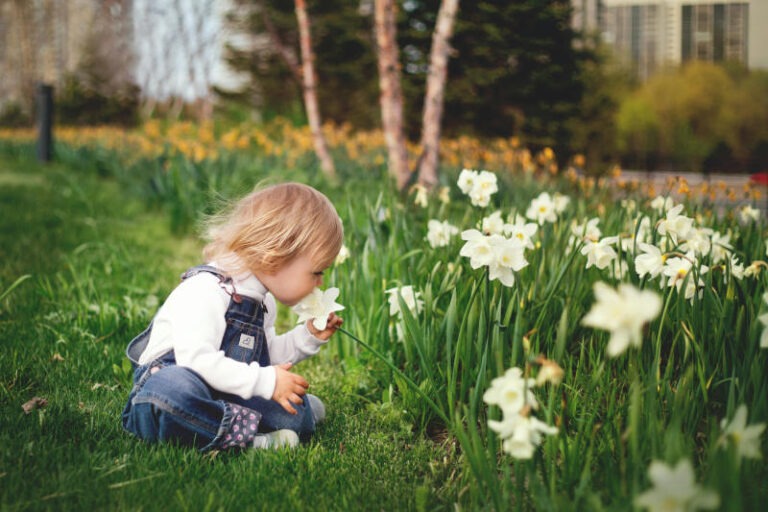
As the frost thaws and the first green shoots emerge, spring offers a wonderful opportunity to bring the outdoors into your setting. For children, this season is a sensory-rich transition filled with new life, vibrant colours, and the excitement of warmer days.
By engaging with the natural world, children can explore the wonders of growth and change while building fundamental skills. These spring-themed activities are designed to be inclusive and engaging, supporting development across all seven areas of the EYFS framework.
1. Spring Sensory Discovery Basket
Fill a large basket or “Tuff Tray” with a variety of seasonal textures, such as artificial grass, smooth river stones, soft silk flower petals, and wooden eggs. You can even add small toy lambs or chicks to encourage imaginative play.
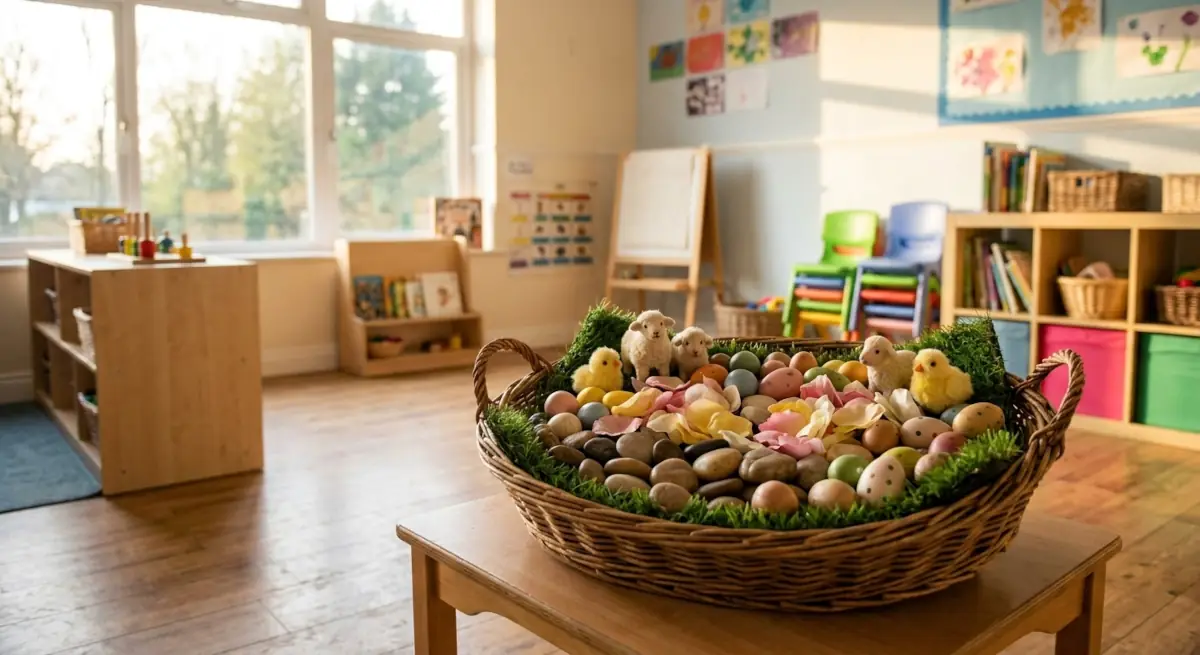
Allow the children to explore the basket freely, feeling the different weights and textures of the objects. For the youngest children, focus on the sensory experience and descriptive language, while older children can begin to sort the items by colour or size, or use the figures to create their own “farmyard” stories.
EYFS Areas of Development and Early Learning Goals:
- Physical Development
- Fine Motor Skills
- Exploring different textures and picking up small objects helps develop the pincer grip and hand-eye coordination.
- Fine Motor Skills
- Understanding the World
- The Natural World
- Encourages children to explore and comment on the natural materials and creatures they might see during the season.
- The Natural World
- Communication and Language
- Speaking
- Using descriptive words like “soft,” “heavy,” or “fuzzy” helps expand vocabulary and expressive language.
- Speaking
2. Planting “Magic” Sunflower Seeds
Provide individual biodegradable pots, potting soil, and large sunflower seeds. Encourage the children to use small trowels or their hands to fill their pots and carefully “tuck the seed into bed.”
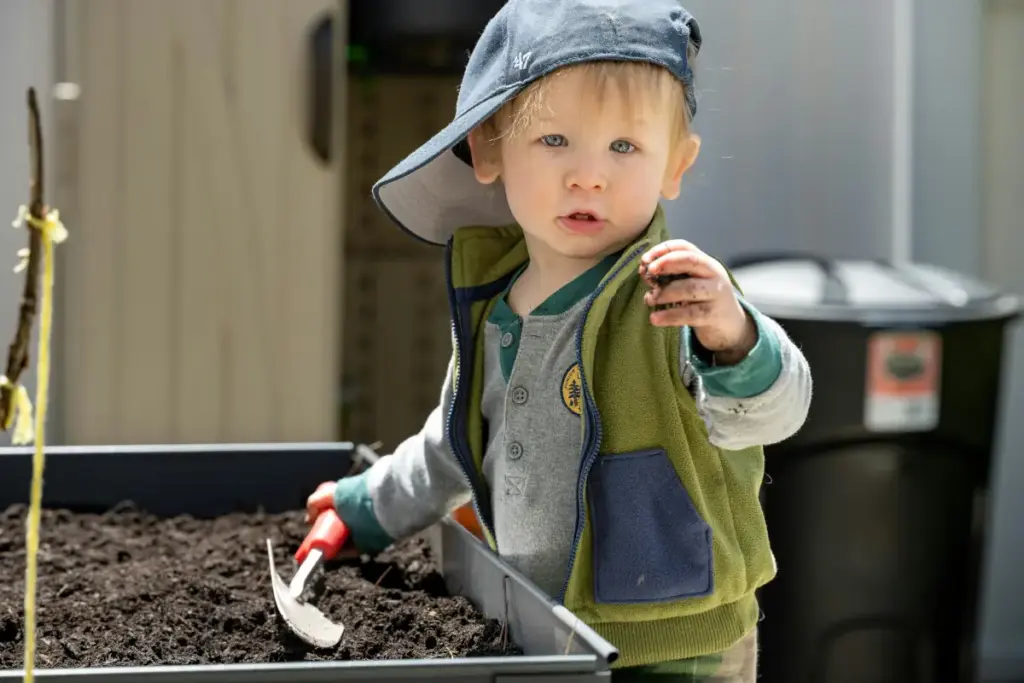
Once planted, involve the children in a daily routine of checking the soil and watering their plants. This long-term project helps children understand what living things need to survive. You can also add a literacy element by having them create or decorate name labels for their pots to keep track of whose “magic” seed is growing the tallest.
EYFS Areas of Development and Early Learning Goals:
- Understanding the World
- The Natural World
- Children learn about the life cycle of plants and the importance of water and light for growth.
- The Natural World
- Personal, Social and Emotional Development (PSED)
- Managing Self
- Taking responsibility for a living thing builds confidence and a sense of contribution.
- Managing Self
- Literacy
- Writing
- Creating name labels or drawing “growth charts” introduces children to the functional use of symbols and letters.
- Writing
3. Spring Petal “Soup” Water Play
Fill a water table or large basin with lukewarm water and a drop of green food colouring or essential oil for a sensory twist. Provide a variety of spring petals (such as daisies, tulips or some early cherry blossom), along with ladles, whisks, and measuring jugs of different sizes.
Children will enjoy “cooking” their spring soup by stirring the petals and pouring the water between containers. This open-ended play allows for deep focus as they experiment with splashing, swirling, and pouring. It is an excellent way to introduce mathematical concepts of volume and capacity in a fun, relaxed environment.
EYFS Areas of Development and Early Learning Goals:
- Mathematics
- Number/Numerical Patterns:
- Filling and emptying jugs helps children understand concepts like “full,” “empty,” “more,” and “less.”
- Number/Numerical Patterns:
- Physical Development
- Gross/Fine Motor Skills:
- Using ladles and whisks builds the larger muscles in the arms and the smaller muscles in the hands.
- Gross/Fine Motor Skills:
- Expressive Arts and Design (EAD)
- Being Imaginative and Expressive:
- Children use the materials to represent something else (soup), engaging in early role-play.
- Being Imaginative and Expressive:
4. Signs of Spring Scavenger Hunt
This activity encourages active exploration of the local environment. Create a simple visual checklist featuring pictures of “Signs of Spring,” such as a yellow daffodil, a bird’s nest, a green leaf, or a bumblebee.
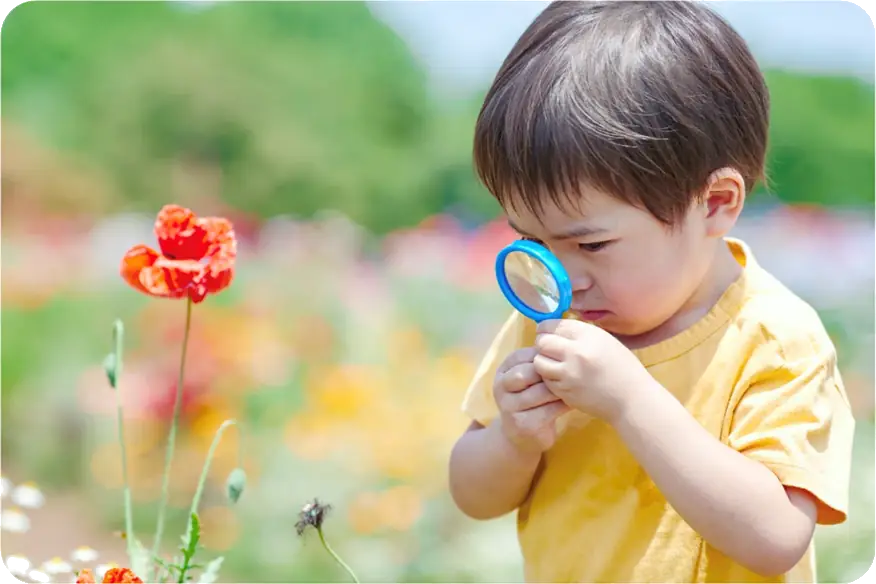
Take the children on a walk around the garden or a nearby park, encouraging them to tick off the items as they find them. This activity turns a standard walk into a mission of discovery, prompting them to look closely at the world around them and notice the subtle changes that the new season brings.
EYFS Areas of Development and Early Learning Goals:
- Communication and Language
- Listening, Attention and Understanding
- Children must follow instructions and listen for clues about where certain items might be found.
- Listening, Attention and Understanding
- Literacy
- Word Reading
- Matching a physical object to a picture and a written word on a checklist is a key pre-reading skill.
- Word Reading
- Physical Development
- Gross Motor Skills
- Walking and navigating different outdoor terrains (grass, paths, slopes) improves balance and stamina.
- Gross Motor Skills
5. Sticky Nature Collages
Tape a large piece of contact paper (sticky-back plastic) to a low wall or table with the sticky side facing outwards. After a short walk to collect fallen petals, leaves, and blades of grass, let the children press their finds directly onto the paper.
Because there is no “messy” glue involved, children can focus entirely on the placement and the “sticky” sensation. The resulting collage becomes a beautiful piece of collaborative art that represents the colours of the garden. It is a fantastic way to celebrate the aesthetic beauty of the season while practicing fine motor movements.
EYFS Areas of Development and Early Learning Goals:
- Expressive Arts and Design (EAD)
- Creating with Materials
- Children explore how different natural materials look and feel when combined to create art.
- Creating with Materials
- Physical Development
- Fine Motor Skills
- The act of peeling, placing, and pressing objects onto the sticky surface strengthens finger muscles.
- Fine Motor Skills
- Personal, Social and Emotional Development (PSED)
- Building Relationships
- Working on a shared collage encourages children to play alongside one another and share a common space.
- Building Relationships
6. Counting “Chicks” in the Nest
This numeracy-focused activity is best for older children who are getting to grips with reading numbers. Create small “nests” using bowls filled with shredded brown paper. Place a number card (1–10) in front of each nest and provide a bowl of yellow pom-poms (the “chicks”) and a pair of jumbo tweezers or a small spoon.
Ask the children to “help the mummy bird” by placing the correct number of chicks into each nest. This activity provides a physical way to practice counting with one-to-one correspondence. Using the tweezers adds an extra layer of challenge, requiring steady hands and concentration to move the soft chicks into their homes.
EYFS Areas of Development and Early Learning Goals:
- Mathematics
- Number
- Practice in counting, numeral recognition, and understanding that a number represents a specific quantity.
- Number
- Physical Development
- Fine Motor Skills
- Using tweezers is a sophisticated task that prepares the hands for the precision needed for future writing.
- Fine Motor Skills
- Communication and Language
- Speaking
- Discussing which nest has the “most” or “least” chicks encourages the use of mathematical language and reasoning.
- Speaking
These spring activities for EYFS are a wonderful way to celebrate the arrival of the new season while supporting children’s development across all EYFS Areas of Learning. From planting sunflower seeds and discovering sensory treasures to exploring nature on scavenger hunts and creating “petal soup,” these activities engage little learners in hands-on, meaningful fun.
For UK nurseries and early years providers, these activities are perfect for fostering a love of the natural world, early scientific curiosity, and collaborative play in young learners. Let the springtime discoveries begin!