


















Is your inclusive practice truly supporting every child with Special Educational Needs and Disabilities (SEND)?
Moving past surface-level efforts, true inclusion fosters a sense of belonging for all.
This article explores the four critical areas of SEND need and offers concrete, actionable strategies to embed effective, long-term support across the Early Years Foundation Stage (EYFS) curriculum.
Why is SEND inclusion important in the early years?
Inclusive practice goes beyond the recognition of Special Educational Needs and Disabilities (SEND); it is the true feeling of belonging. Inclusion does not solely surround SEND but all diversity: race, religion, beliefs, lifestyle, and disability.
There are more children under the SEND umbrella than ever before:
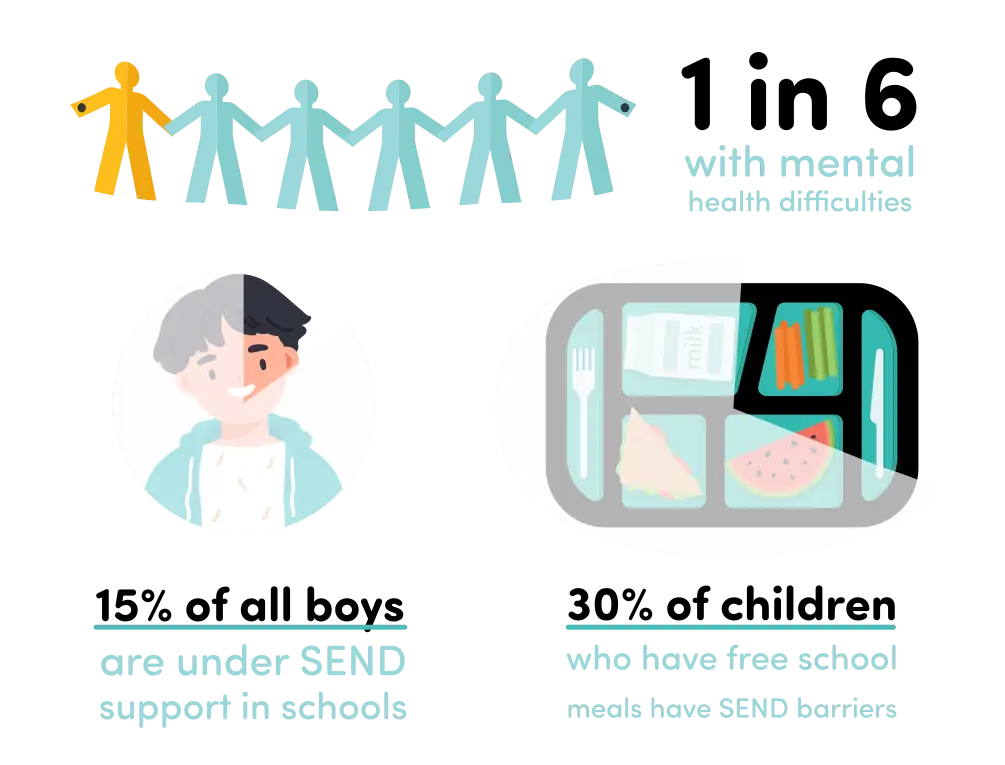
The likelihood of this national SEND picture being mirrored in your nurseries is high, and most likely, only a small handful of children joining your register will have a known, and funded, diagnosis with guidance for supporting them. Your team are often the first educational professionals tasked with identifying and overcoming children’s barriers to learning.
We all want every child in our care to enjoy coming to nursery, to interact with others, and progress as a typically developing child should across the 7 Areas of Learning and Development. But for some, the demands of a social, interactive nursery setting can be overwhelming- this is where we can help.
What is inclusive practice?
Inclusive practice is often confused with the introduction of resources or strategies in isolation to ‘include’ the child in learning opportunities. Think of the use of a wobble cushion for a child with ADHD during story time as they find sitting still a challenge This is a surface level attempt at inclusion.
Now think of an active story time: creating learning activities that are suitable for those with ADHD typical behaviours where the learning incorporates movement, repetition, peer support and visual prompts for the task. That is effective inclusive practice. We must think of the barriers and how our system hinders or helps these challenges, and then, most importantly, change them.
Areas of need for SEND pupils in the Early Years
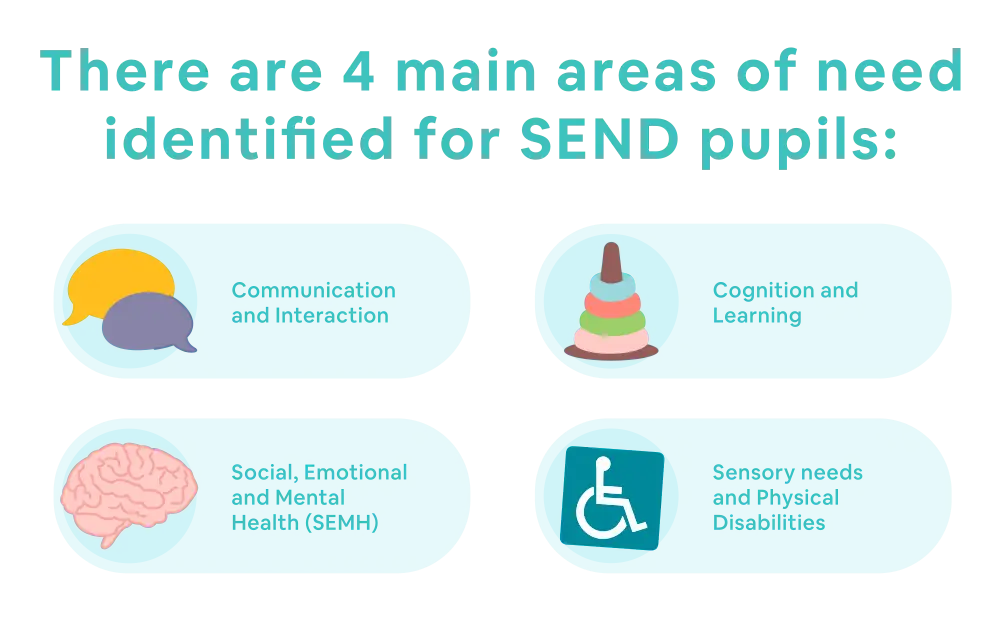
A nursery-wide understanding of the most common signs displayed in each broad category is essential in championing inclusive practice and strategies. Let’s unpick the signs to look out for in each area of need.
Communication and Interaction
All four areas of need span a breadth of needs, the spectrum of needs in the singular area of ‘communication and interaction’ is incredibly broad. This ranges from behaviours associated with Autism, to challenges with phonological retention. The typical barriers your staff will experience here all surround language:
- Difficulties processing the speed of conversations;
- Recognition of what spoken language means;
- Expressing their own wants and needs verbally;
- Understanding social rules in relation to language and others.
This area of need can demonstrate emerging behaviours that highlight the difficulties that a child is experiencing when they are required to interact with others in a social manner. Possible confusion, refusal or anxiety when sharing with others, reluctance when playing games outside of their interests, difficulty taking turns, avoidance of eye contact and misunderstanding social cues that are expected for that age group.
Cognition and Learning
The range of learning difficulties this area of need covers spans from moderate learning difficulties, to severe learning difficulties/profound and multiple learning difficulties, to specific barriers affecting the learning in a particular area of the curriculum. We are specifically referring to Dyslexia, Dyspraxia or Dyscalculia.
Care needs to be taken to distinguish between delayed learning due to high mobility, and adverse childhood experiences (ACEs) We cover how to support ACEs in more depth here.
Social Emotional Mental Health (SEMH)
SEMH is an area of need that is rising across all UK learning settings, especially post-pandemic. These areas can be passive or active which can make spotting the signs extremely challenging. Some examples of passive behaviours your staff may notice may be:
- anxiety
- low mood
- depression
- avoidance of risks
- refusal of praise
- low self-worth
- apathy
- poor friendships
- task avoidance behaviours
Active behaviours relating to SEMH may be exhibited via challenging behaviours such as; over-activity or restlessness; non-compliance with instructions; mood swings; physical or verbal aggression; perceived injustices and a lack of empathy.
Remember, your setting’s aim is to positively respond to areas of diversity. Your enriching activities don’t have to be perfect for all of these behaviours at once. Fundamentally; it is the early recognition paired with the alteration to daily life which allows for an inclusive culture to be adopted.
Sensory needs and Physical Disability
Some children may need additional support as their disability prevents them from interacting with nursery resources in the same manner as their peers. This can be due to a physical disability or they may require additional sensory stimulation in order to meet their needs.
This category of need may include partial or complex vision loss, hearing loss, or multi-sensory impairments. Physical disabilities also include those which are progressive, long-term injury, or diseases such as cancer. More information can be found on the above disabilities here.
Sensory processing difficulties is an area of need becoming more prominent in mainstream educational settings. They involve how the brain processes information via our senses, often experiencing over or under sensitivity in relation to the 5 main senses: touch, smell, taste, sight, sound.
How to make your setting inclusive for SEND children
Supporting a number of children with different interests, needs, and levels of progression is challenging. When you are supporting a child with emerging additional needs in one area or across multiple, the importance of inclusive cultures and practices become essential for their wellbeing and development.
The 7 Areas of Learning and Development, paired with the advisory Early Learning Goals gives us the benchmark for what a ‘typically developing’ child looks like. We have unpicked the 7 areas and identified some quick-try strategies, as well as longer-term curriculum changes, that will allow for a truly inclusive SEND setting.
You can find an in depth explanation of the Early Learning Goals here.
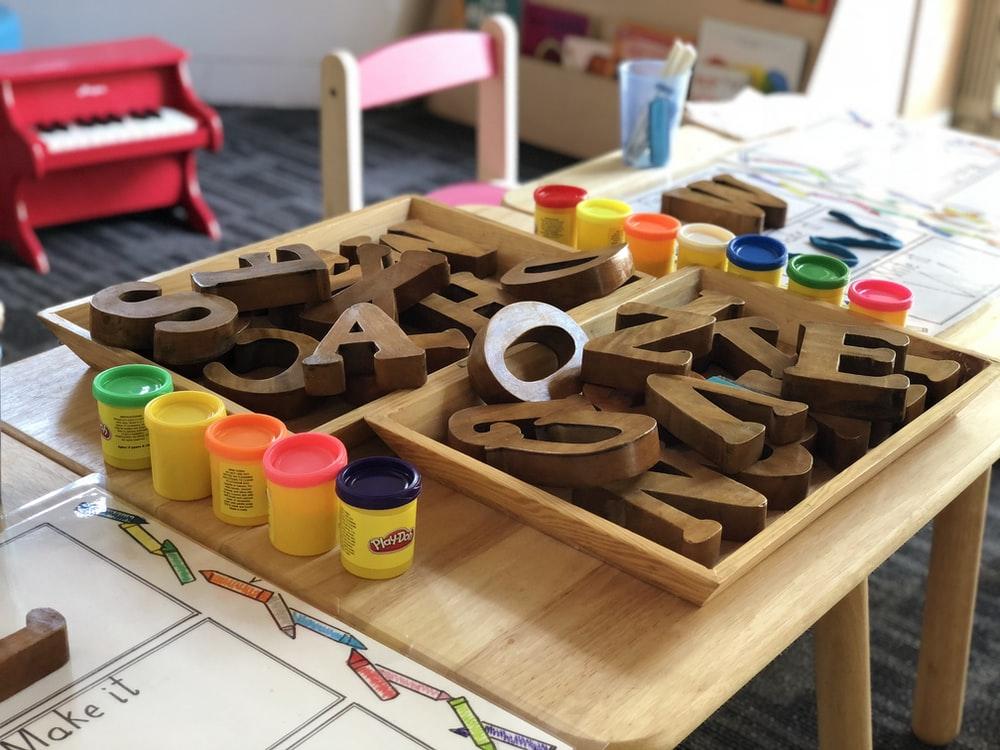
Inclusive practice in the 7 Areas of Learning and Development
Communication and Language
Copy box
Visual timetable
Talking-rich environment
Personal, Social and Emotional Development
Emotional regulation
Modelling
Physical Development
Sensory circuits
Sensory strategies
Literacy
Story stick
Multi-sensory approach to learning
Mathematics
Practical resources
Paper colour
Understanding the World
Now and next sequencing
Social stories
Expressive Arts and Design
Sensory messy play
Cross-curricular links

Image source: learning and exploring through play
The ever-changing dynamic of your nursery’s overall SEND picture can be challenging when creating inspiring, and engaging ideas.
You are the first and most important step when identifying potential barriers to learning, and confidence in identification begins with knowledge of clues to look for.