









Loose parts play, a concept first dated to 1971, encourages curiosity and inventiveness in children by offering open-ended materials.
Creating a meaningful provision for loose parts is essential for fostering developmental growth in your Early Years setting. This article will guide you through understanding the benefits and implementing effective, budget-friendly ideas to spark imagination.
What is ‘loose parts’ play?
‘Loose parts’ play is not a new flash-in-the-pan initiative, it has been first dated back to 1971 where architect, Simon Nicholson described fun and exploratory activities children freely engage with, he explained the need for a variety of items or ‘loose parts’ to create and make connections
In any environment, both the degree of inventiveness and creativity, and the possibility of discovery, are directly proportional to the number and kind of variables in it.
It is a form of relaxed parameter learning, aimed to encourage and foster curiosity-led learning in children by offering ‘loose parts’ to pique interest and spark the imagination for play. Loose part play is strongly featured in the Reggio Emilia approach as well as being recognised by Early Years forerunners such as Montessori, Piaget and Froebel.
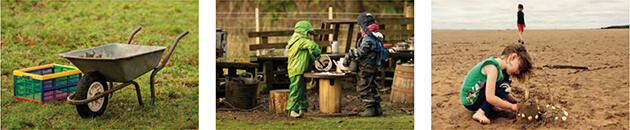
Why is ‘loose parts’ play beneficial in Early Years?
Due to the popularity of loose parts play in nursery settings, several studies have investigated carefully the necessity of having curiosity-encouraging provision within Early Years, and from a practical, everyday perspective the benefits are obvious! The opportunities for social, physical, and developmental growth they found are listed below.
Social benefits
Play is so versatile; it can be solitary exploration or span to a multiplayer wizard and dragon battles. Facilitating a provision where the possibilities are endless is a large task, but when created with thought and understanding of the aspects of play wanting to be developed, it can be the best part of their day.

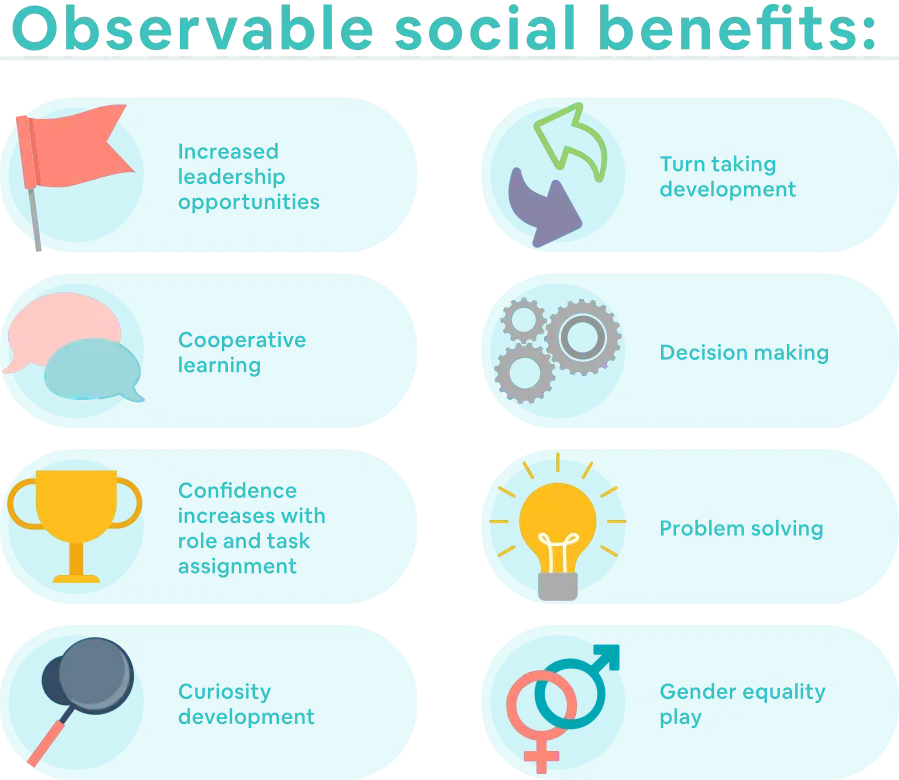
Research has found the following observable social benefits:
Physical benefits
The aim for productive play opportunities is to develop the whole child: socially, personally, physically, and emotionally. The suggested ideas listed below are a great way to encourage both indoor and outdoor exploration of loose parts play in your nursery.
Outdoor opportunity allows for physically active play: running, jumping, climbing, pushing, and pulling. As well as developing strength, coordination, and stamina, which are all fundamental to leading a healthy life, the smaller objects suggested encourage the gross and fine motor skills needed to develop school-ready skills in an engaging way.
Developmental benefits
All benefits available when the children in your setting engage with curiosity-based play intertwine with the four guiding principles from the 2021 Early Years Framework. Encouraging progression within learning, building on their own interests, strengthening positive relationships all whilst advancing their competency at the different play stages.
Who supports the use of ‘loose parts’ play in Early Years?
The detailed descriptions of loose parts or curiosity play have been well documented for decades, it has developed and matured through the years but remains as flexible as your setting needs it to be. It’s supported by several theorists (Piaget, Parten and Smilansky) with the development of play stages; loose parts play offers the perfect opportunity to progress in each stage.
Practice
Symbolic
Games with rules
There are no set ways Ofsted prefer to see learning through play, it relies on your own setting’s needs and the needs of the children. The best settings, find creative methods of hitting all the prime and specific areas of learning and development through a mixture of adult and child-led practice.
How can you make your provision as effective as possible?
Types of play
We all are aware of our children’s favourite games to play, but do we really think about what type of play we are observing? We have collated different types of play and what to look for, to highlight the progressive stages of play.
- Practice/ exploration play
- Collecting
- Sorting
- Placing
- Functional
- Imaginary
- Dramatic
- Goal oriented
- Combination play
- Rule games
Best resources to facilitate loose parts play
In an ideal budget world, you could stock up your room resources with a host of fancy, sparkling new gadgets from a catalogue. But as the premise behind loose parts play is a learning method, the materials used to get the children to learn can be flexible, allowing the importance to be the journey itself.
So, with the natural world and sustainability in mind, we have created an extensive list for your resources. A list that will be able to facilitate over 38 ways to encourage curiosity play and learning, without breaking the bank.
We have chosen to split into four main categories: Natural, Man-made, Temporary and Small parts!

- Wooden coasters
- Logs of different height and thicknesses
- Wood lengths
- Sticks
- Stones and pebbles
- Barrels
- Hedges, willow tunnels
- Sand pit
- Brushes and rakes
- Mud
- Long grass
- Fire pit

- Materials such as: fleece, shower curtains and blankets
- Tarpaulins
- Wooden pallets
- Buckets
- Shovels and trowels
- Tubes, guttering, hosepipes
- Ramps
- Nets
- Tyres
- Trays
- Wheelbarrows
- Baskets
- Old computer keyboards or phones
- Steering wheels
- Dressing up box
- Camping chairs/mats

- Chalk
- Straw and hay bales
- Cardboard boxes and tubes
- Leaves and feathers
- Shells, pinecones
- Air drying clay
- Seaweed
- Plastic bottles

- Golf tees
- Buttons
- Beads
- Pegs
- Climbing carabiners
- Masking tape
- Nuts and bolts
- Money
Loose parts play ideas
Falling into the same ideas to use can be easy, especially when they love exploring in that way! We have used the lists above to create 38 fun and easy ways to refresh your loose parts play ideas.
- Obstacle courses
- Balancing objects on the logs
- Stick spinning in water
- Stone and pebble comparison and classification
- Make a den with the hedge or willow tunnel
- Use different equipment to write in the sand like sticks
- Brush and rake on different surfaces
- Mark making in mud
- Rolling in long grass
- Stack up wood in different structures in the fire pit
- Make a habitat
- Making a den
- Superhero capes
- Make a castle or building
- Carry water or objects
- Dig a moat or trench
- Make a rain catcher
- Create a racetrack
- Fishing game
- Racing in a Formula 1 race
- Test what floats
- Make own ideal playground
- Plane making and testing
- Shape making
- Mark making with chalk
- Balance on the straw bales
- Make a hay bracelet
- Attach to end of stick and paint with leaves or feathers
- Copy an artist’s work with shells and pinecones
- Make a natural mobile for a baby
- Editable artwork
- Golf tees to balance rocks and shells on
- Decorate clay or playdough ice-cream toppings
- Create emotion faces using the small parts
- Longest chain with carabiners
- Create a symmetrical shape or pattern
- Sort and collect the money
- Money treasure hunt
There is nothing more rewarding than creating the nurturing, supportive environment necessary for children to explore boundaries and interests within play. You, as practitioners, plant these seeds every day.