


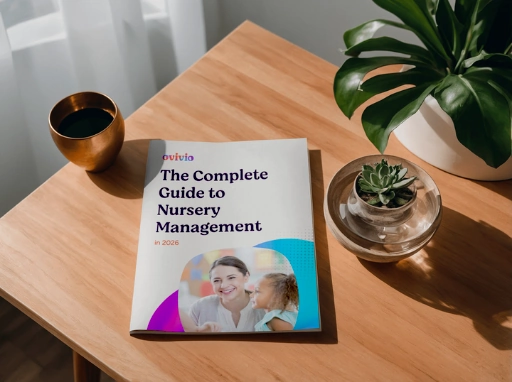
Running a nursery in 2026 is more complex than it’s ever been.
Between evolving Ofsted frameworks, rising operational costs, recruitment pressures and ever-higher expectations from parents, nursery managers are expected to be everything all at once.
You’re expected to be a proficient leader, strategist, HR professional and financial planner, often all before morning snack time.
This comprehensive guide to nursery management is designed to make that easier.
Whether you’re managing a single-site setting or overseeing a nursery group, the complete guide to nursery management in 2026 is your go-to resource for running a nursery that’s compliant, financially sustainable and, of course, successful.
We cover every major area, from structuring your setting for success and navigating the new Ofsted framework to delivering a tailored EYFS curriculum, managing your team, and keeping parents informed and engaged.
This guide is packed full of practical strategies, systems and tools that free you up to focus on what matters: the children in your care and the team supporting them.
You can download the guide just below, or read the summary underneath first if you’d like an idea of what’s in store.
Download the guide:
What’s in the guide?
- Structuring your nursery for success in 2026
- Leadership and Strategy
- Early Years Inspections
- Safeguarding and Health & Safety
- Child Development and Achievement
- EYFS Curriculum and Teaching
- Inclusion and SEND
- Behaviours, Attitudes and Routines
- Nursery Staffing
- Marketing and Occupancy
- Financial Stability
- Parent Communications
- The Administrative Load In 2026
Structuring your nursery for success
Before you can improve any area of your nursery, you need to be clear on what you’re working towards.
That means being honest about your vision, mission and your values. Unpicking what success looks like for your setting in 2026.
- Vision: Where are we going?
- Mission: What are we here to do?
- Values: What guides our decisions?
Your answer to ‘what does a good year look like?’ will be different from every other nursery manager reading this guide.
Leadership and Strategy
Ovivio’s 2025 Childcare Sector Survey found that nursery managers and leaders carry significantly more stress than practitioners. Over 42% reported feeling the weight of leadership pressure in ways that regularly impacted their wellbeing outside of work.
That’s worth acknowledging openly, because sustainable leadership is one of the most important factors in nursery success. Leading an excellent setting when you’re running on empty, isn’t just a fool’s errand, it’s not possible.
Effective nursery leadership in 2026 is built around three questions that will sound familiar (aligning with the older terminology of Ofsted 3 I’s: intent, implementation and impact):
- What are we trying to achieve?
- How are we delivering it?
- What’s the result?
Early Years Inspections
In England, 2025 brought the most significant changes to the Ofsted inspection landscape in years.
The changes to the way Ofsted inspects early years settings have moved us away from single-word judgements towards a process that considers context and aims to make inspections more of a collaborative experience.
Inspections will cover the 6 new evaluation areas, including safeguarding as its own area.
In Wales, Estyn and Care Inspectorate Wales are working more closely together through a new Joint Framework, which will roll out from January 2026.
The shift is towards more integrated inspection between the two bodies, so you’re less likely to face duplicate scrutiny or overlapping visits. Non-maintained nursery settings still receive a 10-day notice period before inspection.
In Scotland, the new Quality Improvement Framework for Early Learning and Childcare Sectors was launched in September 2025 and has replaced the previous frameworks.
The Education (Scotland) Act 2025 also made HMIE fully independent from Education Scotland, which means inspection has more autonomy.
Safeguarding and Health & Safety
Safeguarding runs through every decision you make as a nursery manager.
It’s there when you’re recruiting staff, ensuring you stay within ratio, responding to a concern about a child’s welfare, or having a difficult conversation with a parent.
Your safeguarding culture shows up in whether staff feel confident raising concerns, whether parents trust you with sensitive information, and whether children know they’re safe in your care.
This section covers your statutory baseline, what good safeguarding systems look like in practice, and how health and safety (including mental health) protect both children and staff.
Child Development and Achievement
Personalisation is at the centre of effective child development. Asking simple, but important questions:
- Do you know a child’s baseline?
- Do you know their current achievements and targets?
- Do you know their gaps in developments and any risks for achievement?
The best practitioners carry that knowledge into the room. They respond in the moment, adapting their approach and support strategies, and meeting each child exactly where they are.
Ofsted’s exemplary grading specifically recognises the ability to adapt in real time as a marker of best practice. That kind of responsiveness is built on a strong baseline assessment, regular review of progress data, and high-quality adult interaction.
EYFS Curriculum and Teaching
Your curriculum is your vision made visible. It’s evident in your choices for continuous provision, routines, the questions practitioners ask, the resources you provide, and the opportunities you create.
A brilliantly designed curriculum on paper means nothing if practitioners don’t understand it, believe in it, or know how to deliver it.
Your curriculum is only as strong as the team bringing it to life.
Inclusion and SEND
Inclusive practice means identifying the barriers that prevent children from learning and thriving and removing or reducing them for every child.
An inclusive nursery operates with that ethos as a default.
Early years practitioners face a challenge that primary and secondary schools don’t: children’s brains develop so rapidly in the first five years that distinguishing between emerging SEND and typical developmental variation is difficult.
The most common age for SEND diagnosis in the UK is nine. Years after children have left your nursery. Your nursery team often identifies potential delays and provides support without access to specialist services or additional funding.
Every year, a large group of parents reach out to CAMHS for advice and support, but under-fives remain the lowest age group seen by mental health services. Early years providers work in the gap, often without access to professional support, with limited training and resources.
Behaviour, Attitudes and Establishing Routines
How children settle into your setting, engage with daily life and respond to boundaries tells you whether your routines are working.
Predictable structures help children feel secure, and when children feel secure, they’re free to explore, take risks and learn. Your role as nursery manager is to think strategically to build routines that support children’s emotional development and to support your practitioners in responding when behaviour communicates an unmet need.
The 2025 Ofsted framework has expanded its focus on behaviour and attitudes to explicitly include routines, looking for evidence of your day structure, transition management and regulation strategies in everyday practice.
Nursery Staffing
Your team is your provision. The people in the rooms determine the quality of the experience children have every single day. Which makes staffing one of the most important areas you’ll manage.
Having the right operational tools helps you juggle the necessary admin tasks (ratios, rotas, qualifications, cover), allowing you to lead well.
A team that knows children beyond their own key group and an online child profile keep things running smoothly when staff are off sick or on holiday.
Marketing and Occupancy
Your marketing does three jobs: it fills spaces, it attracts staff, and it builds your reputation.
The goal isn’t necessarily always full occupancy, but that depends on you knowing what occupancy level keeps you profitable and then working to a capacity that suits your children and staff.
Financial Stability
Your nursery needs to be profitable. That’s not crass, and it doesn’t make you less child-focused.
You’re building exceptional facilities for children at the beginning of their learning journey, using every skill and ambition you have to make that happen. Creating a successful business with room to grow is how you sustain excellent provision in the long term. Without financial stability, everything else you’re trying to achieve falls apart.
Parent Communication
Your relationship with parents is one of the most powerful tools you have for retention, reputation and children’s outcomes.
Happy, informed parents stay with you longer, refer other families, and work in harmony with your practitioners. A parent who feels uninformed and out of the loop about their child’s progress will be open to finding an alternative setting that values parents.
The administrative load on nursery managers in 2026
The skills needed to run a nursery effectively are no different to those needed to run a school, but you’re doing it with a fraction of the back-office support, resources and access to staff training.
In our recent childcare sector survey, we found that the majority of nursery managers spend more time on administration than on the work that drew them to the sector. At least 42% of those at every job level reported that the current landscape of work is affecting their mental health, with directors and owners the most impacted.
Download the guide: