








Imagine joining a conversation where everyone is speaking a different language. You want to join in, but without the words, you need immense confidence and resilience just to stay involved. Eventually, that barrier pushes you out of the circle entirely.
This is why communication and language development in early years is essential. It gives children the fluency they need to access every interaction, friendship, and learning opportunity in your setting.
In this blog, we help you build that rich environment, sharing 19 of the best communication and language EYFS activities to try in your nursery.
Why is Communication and Language important in EYFS?
Communication and language can be a tricky area to sum up quickly. Since professional discussions are a key Ofsted inspection activity, it helps to have a nursery-wide snapshot definition ready. When your whole team understands what communication and language actually is, they can confidently explain how it’s prioritised in your nursery.
Think of communication and language as the underground network system for a child’s entire development. It’s a Prime Area of learning because it connects everything else. Without it, children struggle to navigate the world around them. It’s the toolkit they need to build friendships and express complex emotions. It helps them explain their needs and truly get involved in learning activities.
These are cornerstone skills for life, not just the early years. Ultimately, strong language skills are one of the most significant indicators of a child’s school-readiness. That’s why it’s such a crucial part of your EYFS curriculum and why your activities need to be varied.
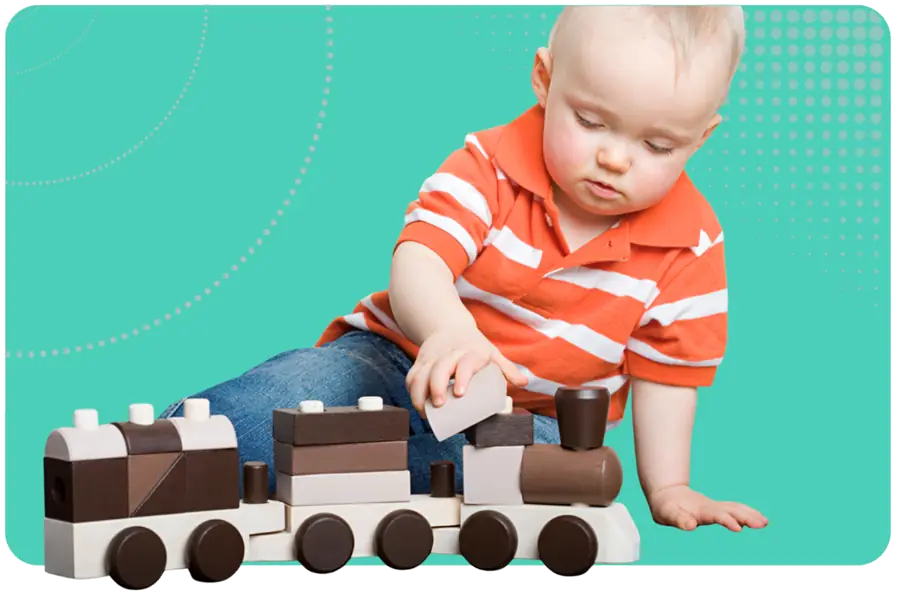
19 Communication and Language Games and Activities
Ofsted looks closely at your curriculum and teaching provision. They check your leadership choices along with how the curriculum is delivered to see if you’re getting the positive impact you expected.
You might still use the 3 Is structure to evaluate your provision, many nurseries prefer to frame their choices using intent, implementation and impact.
Communication and language is central to the Early Learning Goals with a focus on Listening, Attention and Understanding and Speaking. All activities you prepare for your children must align with the EYFS Statutory Framework requirements, and of course, your nursery’s context.
We collated 19 communication and language EYFS activities to cover a broad range of skills outlined in the latest DfE documentation and Ofsted’s Early Years Inspection Toolkit. To make it easy to navigate, we’ve split the broad topic of communication and language activities into:
- Speaking and listening
- Building vocabulary
- Listening, attention and understanding
You’ll also notice a learning link with each game or activity, so you can confidently know how child development is prioritised.
EYFS activities for speaking and listening
These EYFS communication and language games focus on the “back-and-forth” nature of conversation, helping children build confidence in expressing their own ideas while listening to others.
1. Nursery Rhymes
What you need:
Access to your favourite nursery rhymes, from a book, a YouTube video or memory.
How to do it:
Enjoy the rhymes with the children. Repetition helps with recall of word formation and patterns. Remember to use a variety of traditional and modern rhymes to ensure children experience a range of cultural rhymes.
Learning Link:
Develops language and vocabulary acquisition, rhyming patterns and helps with listening and speaking.
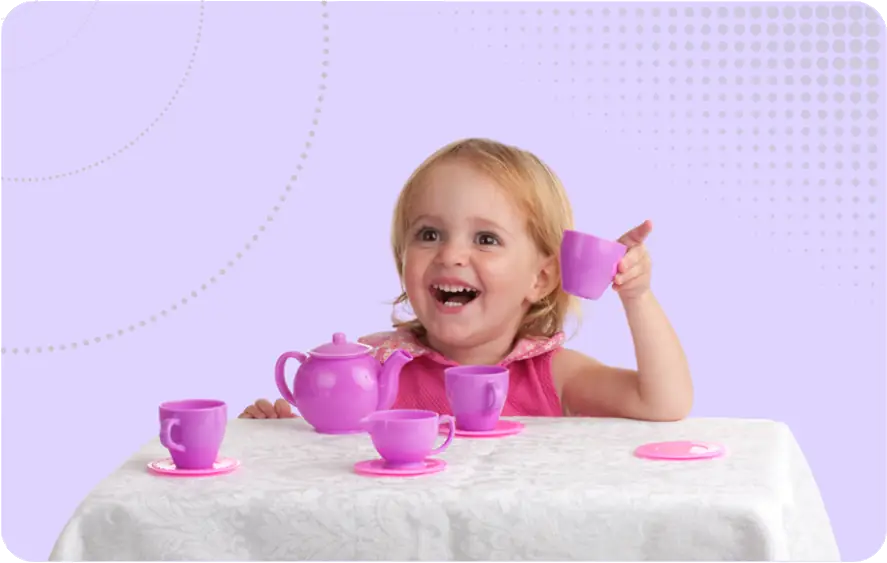
2. Tea party
What you need:
A tea set (real or play), cups, saucers, and a table.
How to do it:
Sit down with a small group of children and hold a pretend tea party. Model the social language of sharing food and drink: “Would you like some more tea?” “Is the tea hot or cold?” Encourage the children to serve each other and ask questions.
Learning Link:
Promotes social interaction and turn-taking in conversation, which is vital for the communication and language EYFS curriculum.
3. Would you rather?
What you need:
Just your imagination.
How to do it:
Ask the children silly or thought-provoking questions to spark a debate. You could ask things like “Would you rather have an elephant’s trunk or a kangaroo’s pouch?” or “Would you rather swim in a pool of jelly or a pool of custard?”
Encouraging them to explain the reason for their choice is the most important part, as it gets them using connecting words like “because” to justify their ideas.
Learning Link:
Moves children from simple naming to complex reasoning and justification, which is a key skill for Reception readiness.
4. Microphones
What you need:
Real microphones plugged into a speaker, a karaoke machine, or pretend ones made from craft materials like toilet roll tubes and foil.
How to do it:
Create a stage or a podium area. Children love the novelty of hearing their voice amplified, and it can be a great confidence booster for shy speakers. You can interview them about their day or let them announce the news to the group. This also links beautifully to EYFS STEM activities by exploring how sound travels and gets louder when using devices.
Learning Link:
Builds confidence and encourages children to experiment with volume and tone while speaking in front of others.
5. Surprise box
What you need:
A cardboard box with a lid or a hole cut in the side, and various random objects like a hairbrush, a toy car or a feather.
How to do it:
Hide an object inside the box so the children don’t see it. Give them clues about what is inside one by one. You might say, “It has wheels”, then “It is red,” and finally “It goes zoom.” Let them guess what it is based on your descriptions. Once revealed, pass it around and ask them to describe it back to you using their own words.
Learning Link:
Encourages active listening and inferencing skills, which help children work out answers based on limited information.

Activities for building vocabulary in early years
These communication and language activity ideas are designed to widen the “word bank” children have access to. As the DfE states, adults build vocabulary by echoing back what a child says with new words added, helping them understand and use new language in context.
6. Makeshift phone
What you need:
Two yoghurt pots and a piece of string, or old disconnected landline phones and mobiles (ask parents or local offices if they have any to donate).
How to do it:
Set up a “call centre” or just let children chat from across the room. Using “real” adult objects often motivates children to engage in roleplay more deeply. You can pretend to order food or call the doctor.
Learning Link:
Encourages conversational turn-taking and imaginative storytelling through communication and language activities for early years.
7. Pom Pom avalanche
What you need:
A colander, some chopsticks or straws and a bag of pom poms.
How to do it:
Think of this as a DIY version of Kerplunk. Thread the chopsticks through the holes of the colander to create a web. Pour the pom poms on top so they rest on the sticks. The children must use their fine motor skills to pull the chopsticks out one by one, carefully. As they do, they watch and wait for the pom poms to tumble down.
Learning Link:
This builds anticipation and patience, which are great for attention skills. It creates a natural opportunity for children to comment on what is happening and shout out when the “avalanche” finally falls.
8. Roleplay ideas
What you need:
Props tailored to a theme (e.g., a bus stop, train station, post office, space station, or garden centre).
How to do it:
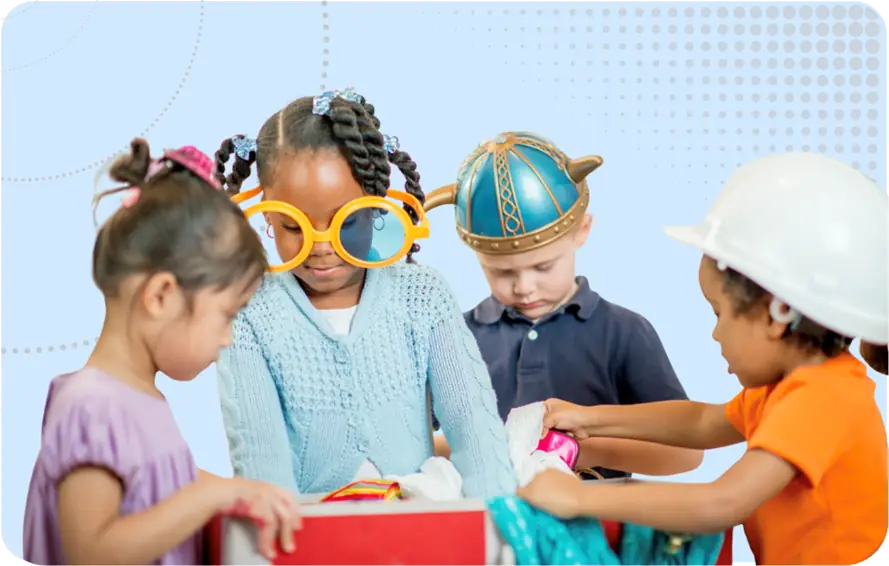
Set up a themed area and focus on the language of that role. If it’s a bus driver, give the children tickets to hand out to their passengers. Encourage the children to ask about their destination, using real or pretend coins to pay for the journey. This can be a great time to practise the expected manners when interacting with others.
Learning Link:
Roleplay is one of the most effective communication and language activity ideas because it embeds vocabulary in a meaningful “real-world” context.
9. Picture stimulus
What you need:
An interesting, unusual, or funny picture (there are lots of free sites where you can find inspiration, like Once Upon a Picture).
How to do it:
Ensure all children can see the image. You might build tension by showing groups of children in a ‘secret’ way using a tablet. Ask the children questions about the image, like, “What’s happening here?” or “What do you think happened just before this picture was taken?” Celebrate all ideas and help them expand their sentences.
Learning Link:
Develops narrative skills and imagination, moving beyond labelling into storytelling.
10. Story stones
What you need:
Smooth stones painted with simple images (a star, a cat, a rocket, a tree), you can buy these in ready-made packs or create them as part of an expressive arts and design activity.
How to do it:
Place the stones in a bag. Children pull one out and start a story. The next child pulls a stone and continues the story using their object. “Once there was a cat… who climbed a tree…”
Learning Link:
Helps children structure a narrative and link ideas together using connecting words like “and then” or “because.”
11. Draw me a…
What you need:
Something to draw with and something to draw on (this can be a stick and the ground, it doesn’t have to be paper and pencil).
How to do it:
Give the child an instruction of what to draw, but add specific descriptive words to test their processing.
For example, “Draw me a fluffy monster”, you can extend this for children who can retain longer verbal instructions by adding “Draw me a fluffy monster with three colourful legs” or “Draw a tiny house with a huge door.”
Remember, there’s no right or wrong when it comes to expressive arts. It’s helpful to choose open-ended objects to encourage creativity.
Learning Link:
Tests their understanding of verbal instructions, colours and numbers within a creative context, requiring them to listen carefully to details without having the pressure of a ‘right or wrong’ answer.
12. Find me the…
What you need:
The nursery environment and various everyday objects.
How to do it:
Instead of asking for an object by its name, ask for it by its function or description to test understanding. You might ask, “Find me something we use to sweep the floor”, or “Find me something that is soft and blue.”
Learning Link:
Enhances comprehension and helps children understand the properties and functions of objects rather than just labelling them.
13. Silly soup rhyming game
What you need:
A mixing bowl, a spoon, and sets of rhyming objects or pictures.
How to do it:
Sing the song: “I’m making lots of silly soup, I’m making soup that’s silly, I’m going to cook it in the fridge, to make it nice and chilly!” Then add ingredients that rhyme.
Use sentence stems to help them: “In goes a…”
- Cat, bat, mat, hat
- Dog, log, frog
- Pan, fan, man, van
Learning Link:
This is a classic communication and language early years game for phonological awareness, helping children hear the sounds within words.
EYFS activities for listening, attention and understanding
These games support children to tune in and process information. By focusing on auditory discrimination and following instructions, they lay the groundwork for future phonics and early reading success.
14. 10 clues
What you need:
One “secret” object or picture hidden from view.
How to do it:
The adult (or child) gives clues about the object, starting with the hardest and getting easier. For example:
- “I am an animal.”
- “I live on a farm.”
- “I have four legs.”
- “I make a noise like…mooo.”
Children guess after each clue.
Learning Link:
Develops deductive reasoning and listening attention, encouraging children to hold information in their heads.
15. Musical statues
What you need:
Music and a speaker.
How to do it:
Play the music and have the children dance. When the music stops, they must freeze. To make it more complicated (and better for listening), give an instruction when the music stops:”Freeze like a tiger!” or “Freeze on one leg!”
Learning Link:
Develops auditory discrimination and the ability to anticipate and react to sound cues.
16. I-Spy
What you need:
The environment around you.
How to do it:
Use the classic phrase “I spy with my little eye, something beginning with…” For younger children, use the sound (phonics) rather than the letter name, or even the colour: “Something that’s blue”, “Something starting with Ssss.”
Learning Link:
Isolates initial sounds in words, a critical pre-reading skill and part of the EYFS communication and language foundation of skills.
17. Feely box
What you need:
A box with hand-holes and various textured objects (pinecone, silk scarf, sandpaper).
How to do it:
This isn’t just sensory play, it’s a listening and vocabulary game. Ask the child to put their hands in and describe what they feel before they pull it out. Ask prompts like “Is it rough? Is it smooth? Is it cold?”
Learning Link:
Forces the child to focus on tactile information and convert it into descriptive language without visual cues.
18. Guess the sound
What you need:
A screen (to hide behind) and instruments or everyday objects.
How to do it:
Hide behind the screen and make a sound (shake a tambourine, crumple paper, pour water, drop keys). Ask the children to guess what made the sound. You can link this to your current learning themes, like animal noises for a farm topic.
Learning Link:
Sharpens auditory attention and discrimination, helping children distinguish between different sounds.
19. Simon Says
What you need:
Space to move.
How to do it:
Give the children instructions like “Touch your toes” or “Clap your hands.” They must only do it if you say “Simon Says” first. If you don’t say the name, they must stay still.
Learning Link:
A vital game for listening and attention that tests impulse control and the ability to process specific verbal instructions.
Creating a language-rich environment doesn’t mean buying expensive resources or overhauling your entire curriculum. Some of the best communication and language activities for early years are often the simplest.
By focusing on the Prime Area of communication and language in EYFS, you are giving children the essential “underground network” they need to navigate social friendships, express their feelings, and succeed in future learning.
If you want to stay ahead of the curve with the latest Ofsted updates, EYFS curriculum tips and EYFS activity ideas, subscribe to our free Ovivio blog and get all things early years delivered straight to your inbox.
For more brilliant EYFS activities, check out our Ultimate guide to EYFS activities blog post and easily cover the seven areas of learning and development!