









In Summary:
The Ofsted Early Years Inspection Toolkit was introduced in September 2025 and further updated in June 2026.
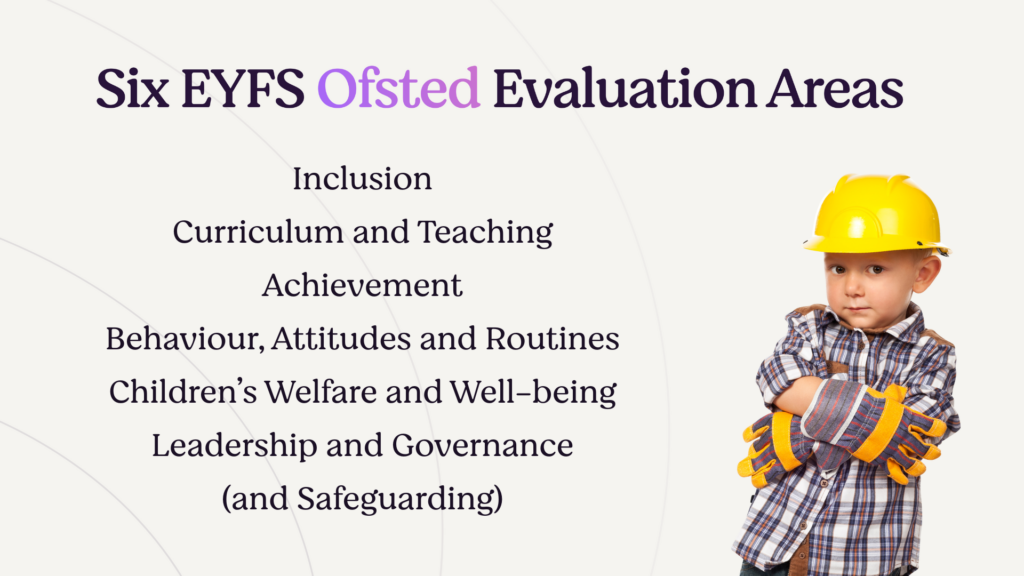
The toolkit is split into six evaluation areas (plus safeguarding) under the new Ofsted Framework: Safeguarding; Inclusion; Teaching and Curriculum; Achievement; Behaviour, Attitudes, and Establishing Routines; Welfare and Wellbeing; and Leadership and Governance.
The toolkit replaced the Early Years Inspection Handbook from November 2025 and shares descriptors of what practice and evidence look like in each of the five new grading judgements: Exceptional, Strong Standard, Expected Standard, Needs Attention and Urgent Improvement.
In September 2025, we saw the largest overhaul of the Ofsted inspection framework and process for decades. A huge number of new guidance and documents were released at the same time.
In June 2026, the DfE released updates to the Early Years Inspection Toolkit. Having implemented the new frameworks and processes in nurseries and other early years settings for over 6 months, the changes tweaked wording and expectations, further clarified the strategic focus of Ofsted.
In this blog, you’ll find an easy-to-understand breakdown of what the Early Years Inspection Toolkit is, what it replaces and what is contained in the 54-page document that inspectors use to evaluate provision.
What is the Early Years Inspection Toolkit for Ofsted?
The Early Years Inspection Toolkit is the operating guide that Ofsted inspectors use when they inspect nurseries.
The main Ofsted changes introduced in 2025 included sector-specific operating guides, giving early years their own set of grade descriptors to help inspectors assess the main areas of evaluation.
Ofsted inspects: early years, state-funded schools, non-association independent schools, FE and skills and Initial Teacher Education (ITE) and each sector has its own toolkit and inspection guidance.
The toolkits follow an Ofsted consultation, which highlighted that inspectors without specialist knowledge often inspect specialist settings (such as early years).
The toolkit aims to make clear:
- Which evaluation areas inspectors must judge
- What ‘expected’, ‘strong’ and ‘exceptional’ practice looks like
- How inspectors will gather evidence (from everyday practice, not piles of extra paperwork)
- Clarity on managing common and uncommon situations that might arise during an inspection
What does the Ofsted Early Years Inspection Toolkit replace?
To see what the new toolkits replace, we’ll need to look at the ‘old’ system (still in place until November 2025) to compare the changes.
Here’s a brief summary of how EYFS inspections used to run (pre-November 2025), and the documents that underpinned them.
How it used to work: EIF and Early Years Inspection Handbook
The Education Inspection Framework (EIF) was a top-level framework that set out Ofsted’s inspection principles and the ways that Ofsted inspected schools. One of the complaints about the EIF was that it was applied to many provider types, using the same guidance for schools and EYFS settings.
The EIF was previously paired with the Early Years Handbook; this was a phase-specific to early years and explained how inspectors would inspect these particular settings. But this was found to be disjointed.
In short, the EIF provided overarching principles that inspectors would follow, and the Early Years Handbook sought to tailor the inspection to nursery settings.
What’s changed: 2025-26 Ofsted updates and new toolkits
The documents released on the 9th of September replaced the EIF. The latest Ofsted framework sets out all the changes introduced in 2025, such as the new report cards and toolkit use.
The Renewed EIF (complete with report card introduction, etc.) came into force in November 2025. Ofsted now uses the setting-specific toolkits and guidance documents instead of the old EIF.
The inspection toolkits or operating guides also came into force in November 2025 for nurseries attached to schools. All Ofsted inspections now follow the newest formats (report cards, five individual area gradings and no overarching final judgement for the school).
The toolkits for early years providers were designed to provide clarity on the grading structure, include new and important evaluation areas (such as inclusion), and offer a clearer structure to help navigate the document and use it for self-evaluation with the focus of sustained and long-term improvement.
And, on that note, let’s look at how the toolkit is set out and structured.
Navigating the Early Years Inspection Toolkit document in 2026
Each of the six evaluation areas (plus safeguarding) follows the same order in the toolkit.
Once you know the pattern, it’s much easier to digest.
Each Ofsted evaluation area follows this structure:
- What the evaluation area covers (its scope and priorities).
- The factors that show strong practice.
- How it looks different depending on age groups and provision types.
- How inspectors will gather evidence.
- What the grades mean, from “needs attention” up to “exceptional”.
Breaking down the Early Years Inspection Toolkit
Safeguarding
EYFS safeguarding has its own category and is judged simply as ‘met’ or ‘not met’. If it’s not met, ‘regulatory action’ will follow.
When Ofsted inspects safeguarding in your nursery, they’re looking for evidence of a consistent, whole-setting approach. Where policies are lived and are visible in how staff support children and families.
It’s about creating a culture where children are always the priority, where every staff member knows their role, and where concerns are raised and dealt with fairly and efficiently.
The updates for September 2026 highlight the expectations on practitioners to actively protect children from harm. Using the Working Together to Safeguard Children and the EYFS Statutory Framework as underpinning requirements.
Because safeguarding practices may look different in every nursery, context matters. That’s why Ofsted will use nursery-specific information on the new report cards to make sure judgments reflect the real risks and needs of your provision.
As this is an area that’s always a priority for inspections, your staff may benefit from revising some of the common safeguarding questions Ofsted ask, so they feel confident when preparing for an inspection.
Inclusion
Inclusion has its own evaluation area for the first time, making it a big focus in all inspections.
When inspectors evaluate how you embed inclusion and inclusive practice across your setting. They’ll be looking closely at how disadvantaged children are supported to remove and reduce their barriers to belonging, achieving and thriving.
The term ‘disadvantaged children’ cover those who face barriers to learning and well-being, including children eligible for EYPP, those with SEND, and children known to social care.
Inspectors will want to see that strategies are lived in practice, whether that’s an effective EYPP plan, an early years SENCo with a development plan, well-thought-out sensory development opportunities or strong partnerships with social workers and specialists.
The toolkit makes it clear that inclusion looks different across various contexts.
They’ll gather evidence using eight common activities designed to see how inclusion is prioritised in daily nursery life.
The inspector will look at how quickly your setting identifies additional needs and supports children and families in creating a plan for support. Importantly, the decisions made must demonstrate their impact on the child’s learning and development.

Curriculum and teaching
The Curriculum and teaching evaluation area is a substantial section of the toolkit. Inspectors will want to see that leaders have designed a high-quality, ambitious EYFS curriculum that meets all the criteria of the EYFS Statutory Framework and ensures children build the knowledge and skills they need in order to be ready for their next step of learning.
The EYFS curriculum should be carefully sequenced, with the prime areas given priority for the youngest children. Communication and language activities are threaded through everything, with inspectors looking for rich vocabulary, high-quality interactions, and a love of stories, songs, and rhymes.
Good curriculum leadership means staff know how children learn, understand progression, and adapt teaching to different rates of development. This includes knowing the barriers that might prevent children from learning, and how to reduce these. For example, knowing the science behind emotional regulation and then using suitable activities to help children learn this skill.
Inspectors will focus on whether activities are chosen with purpose (think Ofsted’s traditional 3I’s format here), how practitioners present and check new information and skills to children, and how play and direct teaching are blended to make learning stick.
The expectation isn’t identical delivery in every nursery, nor should it be!
It’s about showing a thought-through, evidence-based approach that allows all children to access learning.
We know that schools are encouraged to use evidence-based resources like the information shared by the Education Endowment Foundation (EEF). It’s always useful to be up to date with recognised approaches and pedagogies and to check that your EYFS curriculum aligns with what is deemed best practice.
Achievement
When a nursery inspector evaluates the area of achievement, they’re looking at several intertwined concepts. These concepts look at how you and your team assess, monitor and adapt your provision to meet their needs and ensure they progress.
Inspectors will look at how well children are progressing across the seven EYFS areas of learning and development and whether they’re gaining the essential skills and knowledge needed in EYFS.
We also know there is a huge push for children to be ‘school-ready’ and would expect this to be one of the common Ofsted themes for 2026, among other big hitters like provision and progress of vulnerable children, inclusion and safeguarding.
Being ready for their next step into reception relies on strong foundations in communication, confidence, focus, resilience, and curiosity. The prime areas carry particular weight for younger children, while the specific areas come into play as they get older.
Leaders aren’t expected to present data spreadsheets. What matters is how effectively they spot when a child is falling behind and put the right support in place quickly.
Inspectors will check that strategies make a visible difference to children’s progress and well-being, which is why effective EYFS child development tracking should be a non-negotiable in your setting.
The achievement evaluation area is ultimately about whether children leave your setting knowing more, remembering more, and being able to do more.

Behaviour, attitudes and routines
The evaluation area of behaviour, attitudes and establishing routines asks:
How well do children settle, engage, and take part in daily life?
Inspectors will be looking for consistent expectations from staff, clear routines that help children feel secure, and fair responses when things go wrong. Settings that have clear processes to meet the needs of their children, like adopting trauma-informed approaches, will be ahead of the curve here.
This evaluation area isn’t just about managing behaviour and demonstrating positive behaviour management strategies.
It’s about creating a predictable, supportive environment where children show respect, kindness, and positive attitudes toward learning.
Inspectors will pay attention to transitions, snack times, tidy-ups, and all the little moments that show whether routines are working for children.
And, as with all other evaluation areas, context matters here too. What’s ‘appropriate’ for babies will look different for 2–3-year-olds, and routines in a childminder setting won’t mirror those in a large nursery.
What matters is that children feel safe, supported, and ready to learn. The sign of effective provision is visible in the impact your leadership decisions have on your most vulnerable children’s experience in your nursery.
Children’s welfare and well-being
When Ofsted inspects children’s welfare and wellbeing in your nursery, they’ll look to see how you purposefully ensure all children feel safe enough to explore, trust and connect with others.
This evaluation area focuses on how well settings care for children’s happiness, health, and emotional security (intertwining it with the statutory baseline requirements from safeguarding, of course).
Inspectors are looking at the factors that impact children’s welfare and wellbeing, like: secure attachments, healthy movement and diet routines, inclusive environments, tailored nurture and care and an underpinning method of belonging and celebrating differences.
They’ll also want to see how nurseries support disadvantaged and vulnerable children so that difficulties don’t become barriers to thriving. Supporting vulnerable children, although it has always been a priority, is a focal point in many DfE publications, like the Children’s Commissioner Report 2025.
One of the largest updates to the Toolkit, announced in June 2026, is that inspectors will no longer consider what the future provision for disadvantaged children might look like when they grade an evaluation area. If there aren’t any children deemed disadvantaged on roll during the inspection, they can’t predict how the nursery might support them in future.
Strong practice is evident in children who are confident, healthy, and developing independence in care routines, whereas weaker provision is observed in unsettled, unhappy, or overlooked children in the grading guidance.

Leadership and governance
When Ofsted inspects your leadership and governance against the Toolkit descriptors, they initially ensure the EYFS statutory requirements are met before moving on to the expected, strong and exceptional standards.
Inspectors will be asking whether leaders fully understand the EYFS requirements, set high expectations for all children, and act quickly when weaknesses are identified.
Good leadership is also about looking after staff. Inspectors will consider whether leaders avoid unnecessary workload, support professional development through training plans, and build and grow positive relationships with parents and other professionals.
And when it comes to governance, it’s about leaders ensuring improvements are implemented in practice, that staff feel supported, and that children flourish. Strong nursery leaders not only meet requirements but also drive ongoing improvement, share good practice with others and prioritise a healthy working culture.

Final thoughts
The Early Years Inspection Toolkit for Ofsted is one of the biggest inspection changes for nurseries in years. It replaces outdated handbooks with a clear, EYFS-focused framework that intends to reflect what you do each day.
Nursery managers can use the toolkit themselves as a self-evaluation tool to guide training, support CPD plans, and reassure teams. If daily practice is strong, you should already be ‘inspection–ready’.
If you’d like to receive the latest news on all things early years, we have a newsletter for that!
Sign up for our free Ovivio Blog today and get useful updates, just like this article, straight to your inbox.