









Every child who joins your nursery brings their own story with them. Different starting points, different barriers to learning and wellbeing, and different life experiences.
Your aim is to help every child achieve, belong and thrive, setting them up for lifelong learning. But doing that well looks different for every child – and that’s exactly what the EYFS inclusion evaluation area is designed to inspect.
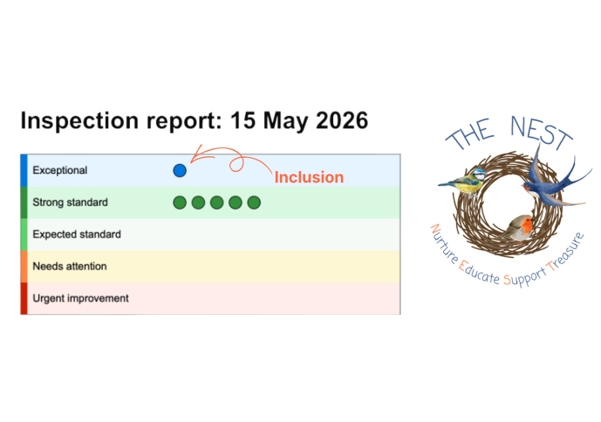
Inclusion isn’t a new concept in early years but how Ofsted inspects it is.
In this article, we unpick the EYFS inclusion evaluation area, explaining exactly what it covers and what Ofsted are looking for. Helping you to prepare for your nursery inspection in 2026.
How Ofsted inspects early years inclusion
The Early Years Inspection Toolkit sets out four specific groups of children the inclusion evaluation area focuses on:
- Socioeconomically disadvantaged children – those eligible for the Early Years Pupil Premium (EYPP)
- Children with SEND, including those receiving SEN support and those with an Education, Health and Care (EHC) plan
- Children who are known, or previously known, to children’s social care
- Children who may face other barriers to their learning or wellbeing, including those who share a protected characteristic under the Equality Act 2010
Extra information:
Supporting disadvantaged children
Inspectors will check that practitioners understand their responsibilities for supporting disadvantaged children and that leaders have a secure understanding of those children’s specific needs.
Supporting children known to children’s social care
Inspectors will look at whether looked-after children receive tailored, high-quality support, whether social care knowledge informs welfare decisions, and whether multi-agency working with social workers and family support workers is effective and well-coordinated.

Inspectors gather evidence against five key factors
1. High expectations for all children
Inspectors will look for evidence that your nursery holds high expectations for every child across the four groups above.
This means ambitious EYFS curriculum planning, strong key person relationships and practitioners who have a secure understanding of potential barriers to learning.
2. Early and accurate identification of need
This is about whether your team knows each child well enough to spot when something is changing or progressing slowly, acting without delay.
Inspectors will look at how quickly emerging or changing needs are identified across all four groups, and whether leaders have the systems in place to ensure nothing is missed.
3. Reducing barriers to learning and wellbeing
Identifying a need is only the starting point. Inspectors want to see what your setting does next – whether appropriate reasonable adjustments are made in line with the Equality Act 2010 and the SEND Code of Practice.
4. The quality and impact of your EYPP strategy
Inspectors will look closely at how EYPP funding is used and whether it is making a measurable difference.
Your EYPP strategy must be rooted in the specific needs of the disadvantaged children in your setting and closely aligned with your improvement priorities.
5. Partnership with children, parents and specialists
Inspectors will look at whether the views and aspirations of children and their families inform the support given. Effective collaboration with external professionals is also something your inspector will be interested in, including whether advice from specialists is sought out, staff CPD training is organised and then how it’s implemented.
The underlying focus across the new Ofsted framework is: How do leaders make decisions and how can you tell their impact on children’s outcomes?
The role of early years SENCo
Inspectors will consider whether your early years SENCo holds sufficient leadership authority, whether the graduated approach is applied consistently, and whether practitioners receive suitable training to implement it.
Leaders mustn’t lower their expectations of children with SEND. The progress of children with SEND must be tracked and reviewed systematically.
The changing picture of SEND
As you’ll be aware, we’re in the midst of the largest change to how SEND children are supported (and funded) in over a decade.
The way Ofsted inspects inclusion in early years will alter as new guidance and requirements are published.
The two recently published documents holding the most significant changes (until the SEND Code of Practice is renewed), are:
- The SEND Reform Consultation (this closes to public opinion in May and we can expect the formal publishing of it in Autumn 2026).
Both documents confirm that high-quality inclusion is the baseline expectation for all settings.
One of the proposed changes include a new duty on nurseries to produce a formal Inclusion Strategy, setting out how they will deliver support across different layers of need. Ofsted’s standalone inclusion grade is the first step in that direction – getting your inclusion practice right now puts your nursery ahead of what is coming.
to stay in the loop with all EYFS-focused Ofsted changes? Subscribe to our free Ovivio blog.
Benchmarking your nursery’s inclusion journey
Meeting the expected standard
To meet the expected standard, as a minimum, leaders must be identifying needs quickly and accurately, holding high expectations for all children and demonstrating that the support provided is reducing barriers.
The use of the graduated approach should be evident, practitioners should be receiving suitable CPD training and the EYPP should be having a positive impact.
Of course, this is a summary of the requirements for meeting the expected standard, you can find the full details in the EYFS toolkit (pages 13-15).
Aiming for the strong standard
The strong standard requires leaders and practitioners to be consistently making a demonstrable difference to the experiences of vulnerable groups.
For your nursery provision for inclusion to meet the strong standard criteria, SEND children’s progress is rigorously monitored, adaptations are systematically and skilfully adjusted as needed, and the outcome is a visible sustained difference.
The word ‘sustained’ matters, meaning impact needs to be ongoing and traceable over time.
How Ovivio helps nursery managers
Having whole-setting visibility of children’s progress, particularly for vulnerable groups, is essential for demonstrating strong inclusion practice.
Ovivio’s child development tracking tools allow you to filter and view progress data by group, so you can clearly see how your EYPP children, SEND children and other vulnerable groups are progressing in comparison to their peers. Having access to this kind of evidence is invaluable when evaluating if your inclusion strategies are working.
Want to know more about the features designed to save nursery managers time and improve visibility?
Get in touch with our friendly Ovivio customer support team to book a free demo.
EYFS Ofsted inclusion resource hub
We’re known for our accurate and helpful articles for nursery managers, and you’ll not be surprised to know we have a whole bank of articles relating to EYFS SEND support and Ofsted.
Here’s some highlights we know you’ll like:
- Preparing your practitioners for your nursery Ofsted inspection
- 23 key Ofsted questions you may be asked
- Ofsted early years inspection toolkit 2025: a summary
- Ofsted documents checklist for nurseries 2026
- Preparing for the Ofsted planning call
- 8 Ofsted inspection activities to expect
- What to expect before and during your nursery inspection
- The 3 I’s in early years 2026
32 Ofsted safeguarding questions and answers for early years - How does Ofsted inspect safeguarding in early years?
- EYFS Ofsted evaluation area curriculum and teaching explained
Sign up to our newsletter for more great content like this!