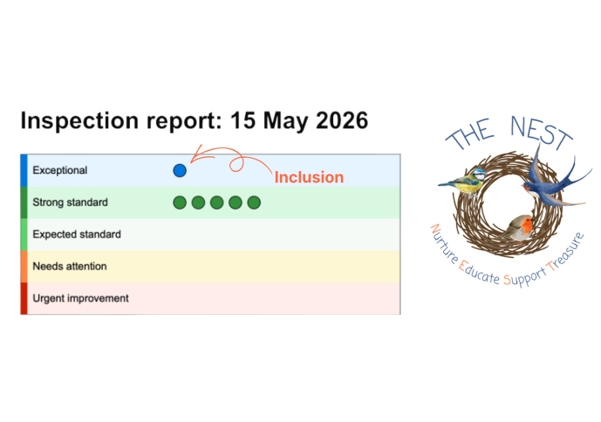




















Ask any nursery practitioner why they do what they do, and you’ll hear it in the examples. The child who finally settled after weeks of difficult drop-offs. The budding friendship that might last a lifetime. The building confidence to try new things.
There’s a common thread running through every one of those moments: a child who feels safe enough to explore, trust and connect with others.
In this blog, we unpick the Ofsted children’s welfare and well-being evaluation area through an early years lens.
We summarise what inspectors look for, what best practice looks like in your setting and share a simple evaluation checklist for your whole nursery team.
How children’s welfare and well-being differ from safeguarding
Safeguarding is threaded through everything your nursery does, and under the updated Ofsted framework, it’s now inspected separately from welfare and well-being. It’s worth your whole team understanding what falls under each.
Safeguarding in early years
Safeguarding covers the EYFS requirements related to child protection and suitability – DBS checks, safer recruitment, allegations procedures and the role of your designated safeguarding lead.
Under the new framework, your setting will be graded as Met or Not Met against statutory safeguarding requirements.
Welfare and well-being
Welfare and well-being cover the broader picture of how children are cared for day-to-day – the quality of daily care, key worker relationships, physical health, emotional security, and whether your setting fosters a sense of belonging for every child.
The two are separate evaluation areas, but the Early Years Inspection Toolkit is clear that where a poor safeguarding culture exists, inspectors will consider whether it’s also impacting on children’s welfare and well-being.

Early years welfare and well-being in a nutshell
The Early Years Inspection Toolkit frames this evaluation area around two things:
- How the setting promotes children’s welfare and well-being
- Whether children receive the care and support they need to achieve and thrive in the setting and beyond
The focus on school readiness
Inspectors aren’t only looking at whether children are happy and well cared for during the inspection visit.
They’ll explore how your setting is building the emotional security, sense of self, and positive behaviours, attitudes, and routines that children need to transition smoothly into the next stage of learning.
It’s the same principles that underpin our own 5 S’s of school readiness framework.
The disadvantaged lens
As with every evaluation area, disadvantaged children (those with SEND, those receiving EYPP and those known to social care) are a particular focus.
If your nursery doesn’t currently have any children who meet those criteria, inspectors will still look at how prepared your setting is to support them if they did join.
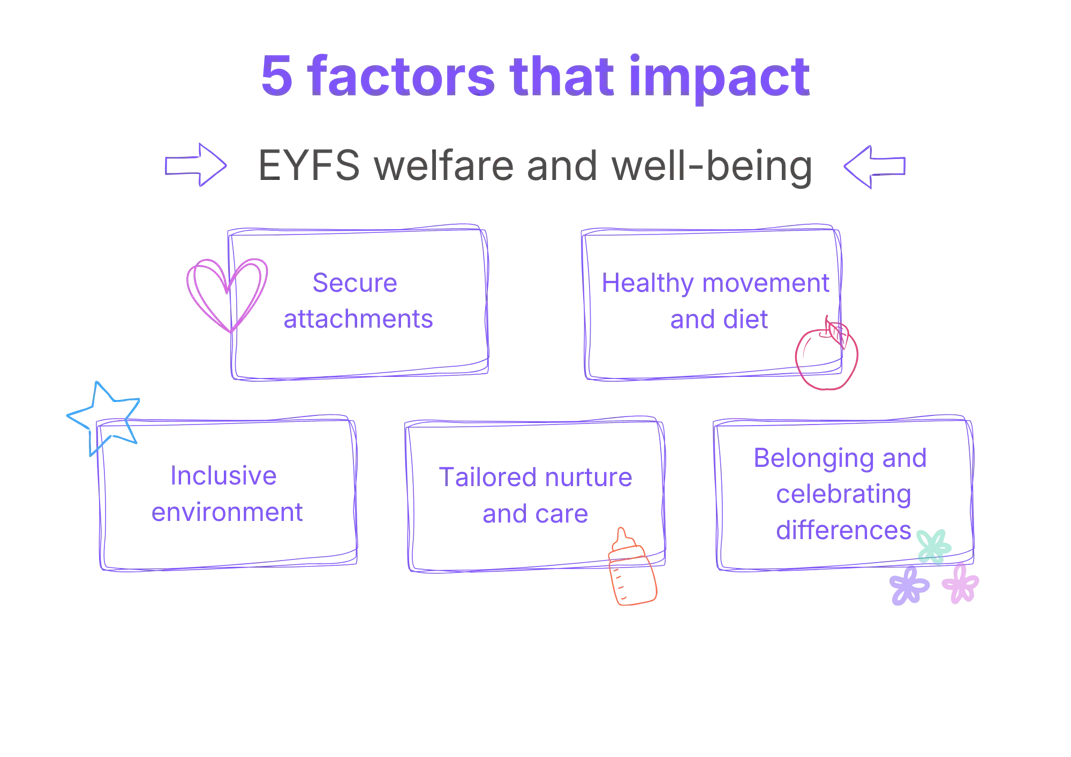
The five factors of effective welfare and wellbeing
The toolkit describes five factors most likely to positively impact children’s welfare and well-being.
1. Building secure attachments
Every child must have a designated key person – that’s a statutory requirement. But the signs that it’s working are seen in the consistency and quality of the connection built between families, practitioners and children.
A strong key person relationship acts as a bridge of emotional safety between home and nursery, building the secure attachments children need to learn, develop, and gradually build their own sense of safety.
Inspectors look for evidence of warm, secure attachments, particularly with babies and the youngest children. They’ll also consider the wider network of relationships around each child – because if a key person is absent, a child’s sense of security should be strong enough to adapt.
2. Sowing the seeds of healthy lifestyles
Combining the prime area of learning of physical development with the building of healthy habits and routines. The second factor that positively impacts welfare and wellbeing is when nurseries clearly sow the seeds of what healthy looks and feels like.
Visible by how practitioners teach and promote understanding that healthy diets and regular movement help their health and happiness. They’ll also look to see if children are encouraged to make their own healthy choices, helping them to build independence.
Inspectors will evaluate if the children have ample opportunities to be active throughout the day and whether the food and drink provided support that.
3. All children deserve the highest quality support
An inclusive environment means every child receives the same standard of care, nurture and understanding – regardless of background, presenting needs or any other factor. Practitioners model this to children, too, building a culture where everyone is valued equally.
Inspectors will look at whether a high standard of inclusion is consistent across your whole setting, with particular attention to disadvantaged children and those who may be at increased risk of mental health difficulties later in life.
4. All children are unique and belong and thrive together
Building on the inclusive environment factor above, this sits at the heart of British values in early years.
Your nursery should ensure all children feel they belong, are celebrated for their unique characteristics and understand that everyone thrives together.
Inspectors will look at whether children are learning, in an age-appropriate way, that what makes each of us different is what makes a community stronger – visible in how practitioners talk about difference, how the environment reflects the children in it and how children are encouraged to include and support each other.
5. Nurture and care match the needs, age and development
Every child in your nursery is at a different stage, and the care they receive should reflect that. With particular attention to baby care routines, including best sleep practices, weaning, and feeding.
Inspectors want to see that these are handled with care and consistency, tailored to each child’s individual needs and stage rather than applied as a one-size approach across the room.

How inspectors gather evidence of effective welfare and well-being
Inspectors will build their picture of welfare and well-being through the 8 Ofsted inspection activity types, including observations, discussions with practitioners and leaders, and checking whether policies are visible in everyday practice.
Unlike in some evaluation areas, much of the evidence here is found in the ordinary moments of your nursery day rather than being visible in collected graphs and data.
Here are some questions to help you self-evaluate your provision across the three areas inspectors focus on:
- Leadership
- Developing and supporting well-being
- Inclusive well-being
Leadership
- Are your welfare and well-being policies followed across every room?
- Do you have a proactive system for identifying children who may need additional support, before concerns escalate?
- Do your practitioners see their key worker role as a care relationship, more than just an admin and observation responsibility?
- Are baby routines, including sleeping, weaning and feeding, handled with individual care and consistency across your whole team? (and how do you know?)
- Are hygiene practices meeting the personal care needs of every child, including children with SEND?
Developing and supporting well-being
- Do children feel confident enough in their relationships with practitioners to speak up when something doesn’t feel right?
- Are children being taught about healthy choices, oral health, screen time and online safety in ways that are meaningful at their age and stage?
- Are children encouraged to take appropriate risks and meet challenges, both indoors and outdoors?
Inclusive well-being
- Do your most vulnerable children experience the same warmth, belonging and quality of care as their peers? (and how do you know?)
- Are children being supported to manage their own personal needs with growing independence, at a pace that’s right for them?
- Is your setting’s culture one where differences are respected and where any form of bullying or discrimination is not tolerated?

Welfare and well-being: A checklist for your nursery team
Use this checklist as a starting point for your next staff meeting. It’s designed to help your whole team evaluate your current provision and feel confident in this area ahead of your nursery inspection.
- Does your key person system hold up when key persons are absent? Is this due to planned systems and support, or is it left to chance?
- Are your September 2025 safer eating and allergy requirements embedded in daily practice across every room?
- How does your team identify when a child is struggling emotionally, and is that response consistent?
- Do the children who find belonging hardest receive the same warmth and attentiveness as those who settle easily?
- Is individual care information available and accessible to anyone who needs it?
- Are babies’ sleeping, weaning and feeding routines followed consistently by everyone who cares for them?
- Who is responsible for the overall welfare and well-being provisions in your setting, and does every practitioner know the process for raising a concern or suggestion for better practice?
- When you walk through your setting on an ordinary day, does the care feel warm and nurturing, and are relationships prioritised?
Found this useful? Share it with your practitioners – the checklist works just as well as a team conversation as it does as a solo reflection, especially if you’re in the inspection window for 2026 and 2027.

Preparing for your nursery inspection
When children’s welfare and well-being are prioritised, you feel it as soon as you step into a setting: the relationships, the routines, the responsiveness to individual need.
For many practitioners, much of this comes naturally, but the strongest nurseries don’t leave it to chance. Their CPD plans, policies, and expected practice are deliberately designed to create that environment consistently across every room, every day.
If you’re looking for advice, strategies, and ideas to strengthen your nursery’s systems and ways of working, our free Complete Guide to Nursery Management in 2026 covers inspection readiness, compliance, and finances in one place.
Other blogs in our Ofsted series you might like:
- What to expect before and during your nursery Ofsted inspection
- 32 Ofsted safeguarding questions and answers for early years
- Ofsted 3 I’s in early years for 2026 inspections
- The Ovivio Nursery Ofsted Glossary
- How Ofsted inspects safeguarding in early years
- How Ofsted inspects inclusion in early years
- Nursery achievement: your Ofsted summary guide
- Nursery leadership and governance: your Ofsted summary guide
- Preparing your practitioners for Ofsted inspection
- Preparing for the Ofsted call: A guide and checklist for the early years planning call
- 8 Ofsted activities to expect during your early years inspection in 2026
- Ofsted inspections in the early years: 23 key questions you may be asked
- Ofsted early years inspection toolkit 2025: a summary for nursery managers