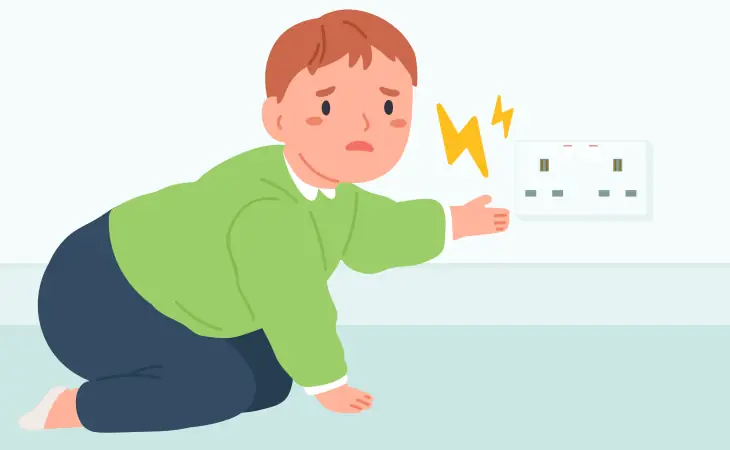
Are you certain that your children are in a plug protected environment whilst at your setting? Not only plugs, but are your electricity EYFS safeguarding policies up to date? Although the number of child hospitalisations due to electrical shocks caused by plugs are on the decline, it doesn’t mean they are without their dangers entirely. It’s worthwhile revisiting your setting’s wiring and electricity safety status not only to prevent electrocutions, but also to defend against setting electrical fires.
How do I know my setting is protected against electrocutions and fires?
Like with many aspects in life, prevention is better than cure. This can certainly be said when it comes to protecting your children from the dangers of plugs and electricity overall. Using the advice from Electrical Safety First, we’ve gathered a checklist to help. Signs your setting works to prevent electrocutions and electrical fires:
Plug sockets are not overloaded
Appliances are unplugged overnight
Cables are positioned mindfully
All older appliances have been checked for fraying and scorching
No electrical appliances are present in any bathroom
You use one multi board/ bar adaptor per socket
Let’s talk more about keeping an online record of all your plug and electricity safety checks
Book your demo
A plug socket cover or RCD: what’s worth it?
The most talked about plug safety options come down to plastic plug covers and RCDs (residual current devices). But what options are right for your nursery setting, and what options truly place children’s and staff’s safety at the forefront?
A plug socket cover
You might be surprised that plastic socket covers could pose more of a potential risk to your children than not having them at all! This has been confirmed by the Department of Health stating that, “13A electrical socket inserts should not be used in health or social care premises.” This is because UK plug sockets are fitted with certain government-regulated safety features already.
Firstly, the pinholes have also been built small enough that a child’s finger could not fit inside. Secondly, the live pins have shutters that only open when the earth pin is inserted (i.e. the shutters prevent anything that is not a plug from reaching live electricity). And it is possible for a curious child to play with the plug safety cover and place it into the socket upside down (difficult but not impossible), which would open the shutters, and effectively undo the initial protection, as confirmed by the NHS.
Why you shouldn’t use plastic socket covers at your nursery setting
RCD protection
Instead of clicking ‘add to cart’ on a plug safety cover, we’d recommend making sure that all your sockets have RCD protection, and then get an electrician to confirm that all your shutters are in fact working as designed. RCD protectors are sensitive safety devices that switch off electricity automatically if they pick up a fault. Therefore, they can be life-saving for a number of reasons as they:
Prevent you from getting a fatal electric shock if you touch something live
Offer some protection against electrical fires
Are available in different, affordable types for each user
Types of RCDs available
Fixed RCDs
Socket-Outlet RCDs
Portable RCDs
How much does it cost to protect my setting?
If you choose to go the RCD route, this can vary depending on which type of device you choose for your setting. A plug-in RCD will cost around £10 per, whereas a fixed RCD will be more (plus installation fees). Although, they will provide more protection as discussed above.
Plus if you have additional concerns that need checking (discussed below), there of course will be a callout fee from an electrician. Each service has their own price list, but as of 2022 you can expect the average London electrician costs to be around £35-£60 per hour, or £280-£450 for day rates. It’s not advised to skimp out on hiring a qualified professional when it comes to your wiring and electricity as the results of poor work could be deadly.
Budget for an electrician easily with a software that does it for you
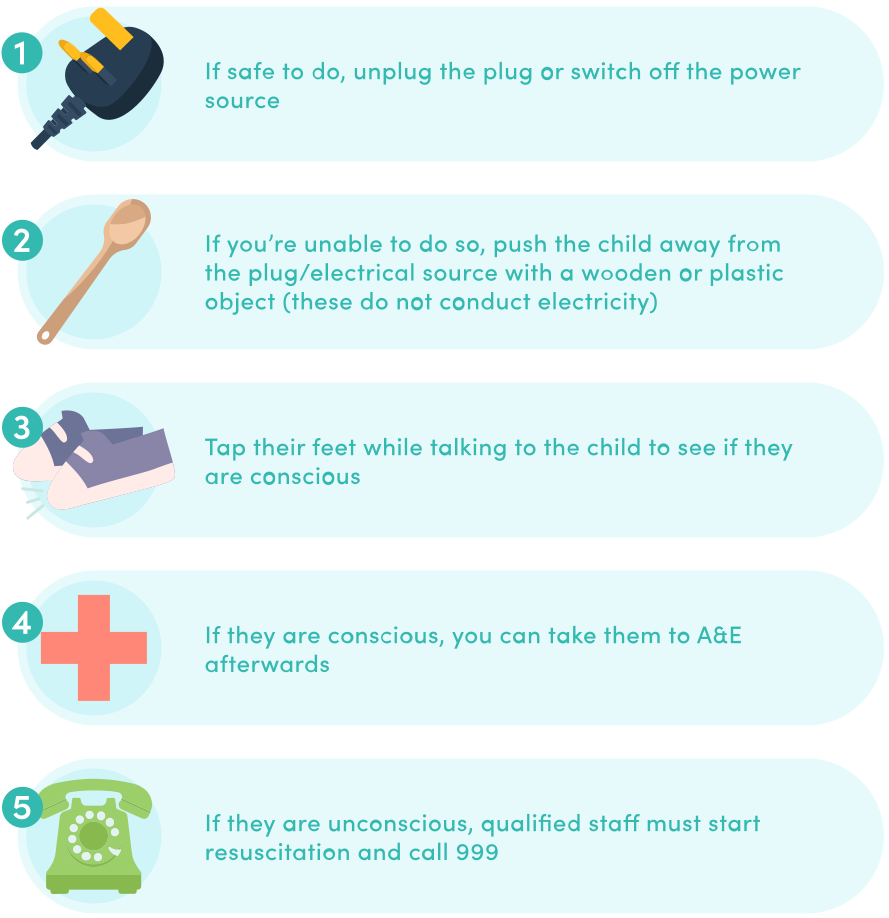
What to do if a child has been electrocuted, according to the NHS:
What to do in the case of an electrical fire at your nursery setting?
Should there be an electrical fire at your nursery setting, there are certain steps you should take to protect its contents: both living and non-living. Mainly, you should evacuate the premises, call 999, and make sure everyone stays out of the danger zone.
If, and that’s a big ‘if’ we might add, it is safe to do so you can pull out the plug causing the fire and/or switch off the power at the fuse box. It is possible that these actions may stop the fire immediately. It’s also essential to note that you must never put water on an electrical fire.
Water is a conductor and this increases the risk of electrocution with this type of fire. This is where fire and emergency EYFS safeguarding policies are vital at your setting. Are your policies easily accessible for all staff? When last did you examine your policy? Perhaps it’s time for a refresher course with staff.
I want to keep all my EYFS safeguarding info protected in a cloud-based system
Book your demo
When should I call an electrician?
There are certain danger signs that you can look out for, and that will signal it’s time to call in a professional. As advised by Electrical Safety First UK and other expert sources, here are some indications that something is not quite right.
When should you call a professional?
What to do if a child has been electrocuted, according to the NHS
If any wires are sticking out, or coming loose from your plugs
Your cables are frayed or show signs of damage
Sockets, plugs, and appliances often overheat
The cable of an appliance is no longer firmly attached
Legal/ Ofsted requirements and check ups
When it comes to fire safety in Early Years, the main document is the Regulatory Reform (Fire Safety) Order 2005 which states that a responsible person should take steps to reduce a fire and make sure that everyone can evacuate the premises in the event of one.
Northern Ireland and Scotland have different documents [Fire Safety (Scotland) Regulations 2006] and (Northern Ireland Fire and Rescue) which have nearly identical legislation, just different documents.
According to the HSE (Health and Safety Executive) the law does not explicitly state how often checks should be done. The advice is that based on the risk of an item becoming faulty, and the environment it’s used in, it is up to you to decide on how often checks are conducted.
You may have also heard about PATs (portable appliance tests). While it’s important that you hire a professional regularly enough for your setting, it should be noted that PATs don’t always need an outside source to assess properly. A simple check by your staff can suffice. Such as, are there any loose wires or signs of scorching?
Also, if you have chosen to implement RCDs at your setting, you need to check on them regularly. Depending on which type you have chosen, regularity of inspection varies. For example, it is recommended that you check all your fixed and socket RCDs every 3 months. And that you test portable RCDs before each use.