









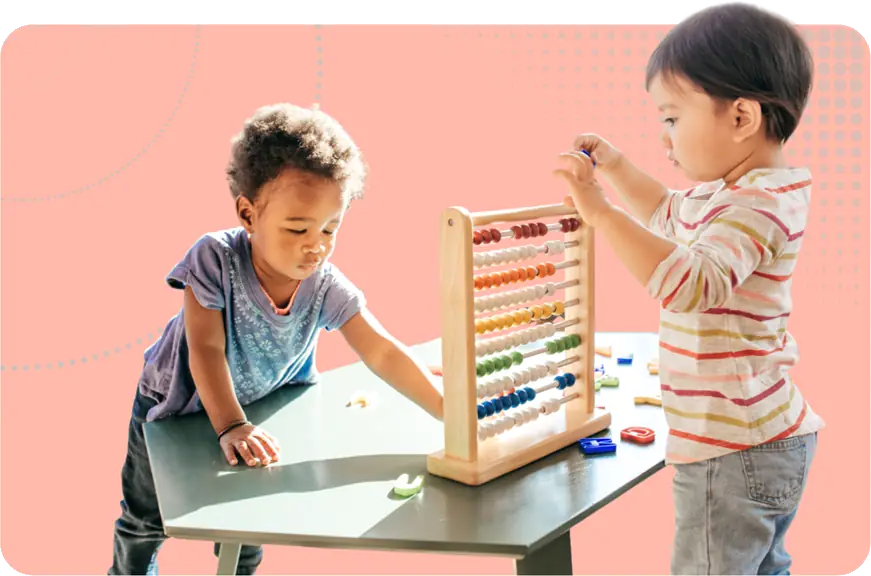
Your EYFS curriculum covers everything the children learn and experience while they’re with you.
The new Ofsted evaluation area of curriculum and teaching is your opportunity to demonstrate exactly how your planning supports children’s development and how your practitioners deliver that learning in practice.
In this article, we unpick the early years curriculum and teaching evaluation area, highlighting exactly what it is and what Ofsted are looking for. Helping you to prepare for your nursery inspection in 2026.
What Ofsted are looking for
Under the new Ofsted framework, this evaluation area effectively merges the what (curriculum) and the how (teaching) of your setting.
It considers whether you provide a high-quality, ambitious curriculum that is designed to fit your context and whether your team delivers it effectively to ensure every child achieves, belongs and thrives.

An ambitious early years curriculum
Ofsted’s early years inspection toolkit makes it clear that your curriculum must be ambitious and meet the full breadth of the EYFS statutory framework as a minimum.
You know your children and the community you serve best. Your EYFS curriculum should be designed to reduce the barriers to learning and wellbeing your children face, ensuring all children are equipped with skills for success.
Ofsted will look to see how ambitious your curriculum is for vulnerable groups of children, especially children with SEND, known to social care and receive additional funding like EYPP.
Intent and breadth
Inspectors will look for evidence that your curriculum equips children with the knowledge and skills they need for their next stage of learning. It requires a clear vision of what you want children to learn and why, ensuring no area of learning is narrowed or overlooked.
Coherent sequencing
It’s not enough to have a nursery day packed full of fun EYFS activities. Your curriculum must be coherent and sequential.
Inspectors want to see that you have planned for children to gain knowledge incrementally, building on what they already know.
Ovivio’s Child Development tools support this by allowing you to track where children are on their journey. Evidencing that your provision follows a logical, data-informed sequence.
High-quality teaching
In the early years, teaching is a broad term. It covers the vital role every member of your team plays, whether that is through interactions during play, modelling language, or setting up the physical environment.
Ofsted recognises that teaching happens in many ways, from explaining and demonstrating to facilitating play. Every practitioner has accountability for children’s outcomes, regardless of their job title.
Inspectors will observe how your team adapts in the moment to respond to children’s curiosity and understanding.
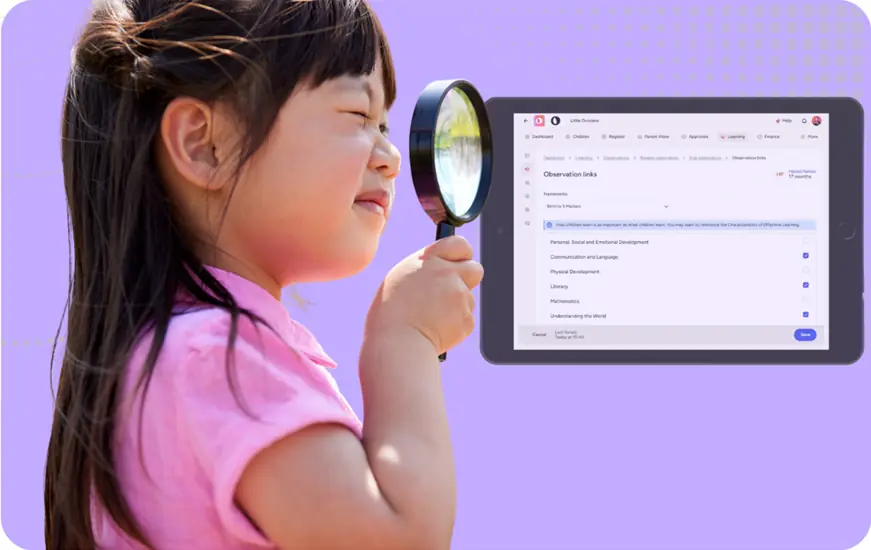
How Ofsted inspects curriculum and teaching in early years
Your nursery inspector will gather first-hand evidence by observing the day-to-day work of your setting, often alongside leaders. This helps them to see if the ambitious plan you discussed in your Ofsted planning call is visible in everyday nursery activities.
The EYFS curriculum should act as the vehicle to achieving good outcomes , with quality early years teaching making sure all children reach their goals, ready for their next step in their learning journey.
Case sampling and vulnerable groups
Case sampling is a key part of the latest inspection methodology. It involves tracking nursery experiences of specific children, particularly those from vulnerable groups.
The inspector will explore how your curriculum is inclusive for all children, underpinned by high-quality EYFS British values.
They’ll be interested in how your nursery team identify gaps in knowledge and skills quickly, and how effective their adaptive teaching skills are to close those gaps.
Many nurseries track early years progress online, accessing evidence to show how you prioritise the visibility of every child’s progress.
With Ovivio’s EYFS tracking feature , progress data can be filtered and tracked easily. This demonstrates exactly how gaps are identified and shows the impact of your planned interventions on the learning and wellbeing of children.
Communication and school readiness
Throughout the day, inspectors will pay close attention to how you prepare children for their next stage in education . As expected, communication and language are featured heavily in the toolkit as the foundations of school readiness.
During learning observations, inspectors will be looking for evidence of quality interactions. Wanting to see a language-rich environment where practitioners model vocabulary and encourage back-and-forth conversation.
They’ll expect to see that your curriculum prioritises these skills using activities that will support school readiness.
A variety of inspection activities
As we know, Ofsted will want to see an accurate representation of what it’s like to be a child in your nursery on an ‘average day’. In order to get a balanced understanding of this, the inspector will use a variety of inspection day activities.
A prominent activity is professional discussions with leaders and practitioners (and children where appropriate).
Prepare your practitioners for your nursery inspection by discussing all parts of your EYFS curriculum with them. It might be helpful to use commonly asked Ofsted questions as a starting point, helping practitioners to confidently talk about the intent, implementation and impact (the 3I’s) of your curriculum and their teaching.
Although the 3I’s are an older term and aren’t mentioned in the latest Ofsted framework, they’re still a tool used by many managers as a structure for professional discussions.

Benchmarking your EYFS teaching standards
When it comes to the inspection itself, the quality of the daily interactions between your staff and the children are what demonstrates your EYFS curriculum in practice.
Meeting the expected standard
To meet the expected standard, the baseline is that your curriculum is taught well. Inspectors need to see that your practitioners understand what children need to learn and are delivering it effectively.
- Tailored teaching: Teaching must be tailored to children’s different starting points, needs, and stages of development. It is not a ‘one size fits all’ approach.
- Checking understanding: Staff should use assessment to check what children know and can do independently. Meaning any children who need to ‘keep up’ or ‘catch up’ can be targeted and supported early on.
- Focus on the prime areas of learning: There must be a clear priority on personal, social, and emotional development (PSED) across the whole nursery from birth to age 5. Communication and language activities will be naturally underpinning all EYFS activities, and children will have ample opportunity to develop their physical development skills.
Of course, the early years inspection toolkit has far more detail, when you’re analysing your curriculum provision, these are a good starting point.
Aiming for the strong standard
To push for a strong standard, the early years teaching must be highly effective and embedded consistently across the setting . It moves beyond just delivering an activity to being truly responsive to every child’s needs.
- Every interaction counts: Practitioners understand that every interaction is an opportunity for teaching and learning. It is not just about set activities but about the learning that happens in all of the quiet moments (intentionally, not by accident).
- Adapting in the moment: Staff need to be skilled at adapting their teaching in the moment. Responding to a child’s emerging thinking or curiosity. If a child shows interest in a topic during garden time, can the practitioner pivot immediately to extend that learning?
- Assessment through interaction: Strong practitioners use their high-quality interactions to assess what children know as it happens. They identify gaps quickly during play and take prompt action.
Creating time for quality interactions
One of the biggest barriers to reaching Ofsted’s strong standard is often time. Time to be present with the children’s learning, allowing practitioners to adapt, extend and support in the moment.
This can’t be done if a large chunk of time is spent documenting their progress through nursery observations.
This is where Ovivio’s Bloom (AI) becomes a strategic tool. By speeding up the administrative side of observations, practitioners are given time back to be present with children.
Keeping parents informed of their progress, without sacrificing precious interaction time writing up observations.

How Ovivio helps nursery managers
The new Ofsted framework demands clear sequencing, ambitious planning, and, most importantly, time for high-quality interactions.
It shifts the focus away from collecting data for the sake of it and onto how strategic interactions improve the lived experience of the children in your nursery.
Cohort progress reports
Having visibility of whole cohort and nursery progress is essential for every manager. Our cohort reports compare children in specific groups, and across areas of learning for true progress visibility.
Nursery administration in one place
Ovivio (formerly Blossom Educational) is a well-known and trusted nursery management platform. Supporting managers to streamline systems and processes they need for a successful nursery. Ovivio does the heavy-lifting for managers who want more visibility and less admin-heavy tasks.
Ready for inspection in 2026
We’re known for our easy-to-use nursery management features. Meaning your essential documents, from staff qualification records to child attendance logs , are accessible in a few clicks, all securely stored in one place.
When your nursery admin systems are seamless and your curriculum is clearly tracked, you have the freedom to focus on what matters most: providing an ambitious education for the children in your care.
Book an Ovivio demo: