


It’s no surprise that the new Ofsted inspection framework has left many early years leaders unsure about what to expect. It marks the biggest change to inspections in years, and with so much shifting, it can be hard to tell what still applies and what’s new.
This article explains what to expect before and during your nursery Ofsted inspection (from November 2025 onwards), using information taken directly from Ofsted’s Early Years Inspection Toolkit and Inspector Operating Guides.
New early years Ofsted inspections at a glance
Here’s a quick overview of what nursery managers can expect from the new Ofsted inspection framework update:
- Inspection window: currently every six years, reducing to four from April 2026 (as set out in the Giving Every Child the Best Start strategy)
- Length of visit: around six hours for full-day nurseries
- Inspector arrival: not before 8 am and finishing by 5 pm, unless key activities usually happen outside those hours
- Notification: settings are informed before 10 am on the working day before inspection (unless it’s unannounced)
- Key documents: Early Years Inspection Toolkit, Inspector Operating Guides, and Early Years Inspection Guidance
- Inspection focus: six new evaluation areas, plus safeguarding. With emphasis on how leadership decisions help children achieve, belong and thrive
- Term-time settings: not inspected in the first week of a new term
- Inspectors: usually one per setting, unless the nursery is large or complex
- New settings: inspected within 12-18 months of opening
- ‘Needs Attention’ outcome: reinspection within 12 months
- ‘Urgent Improvement’ outcome: reinspection within six months
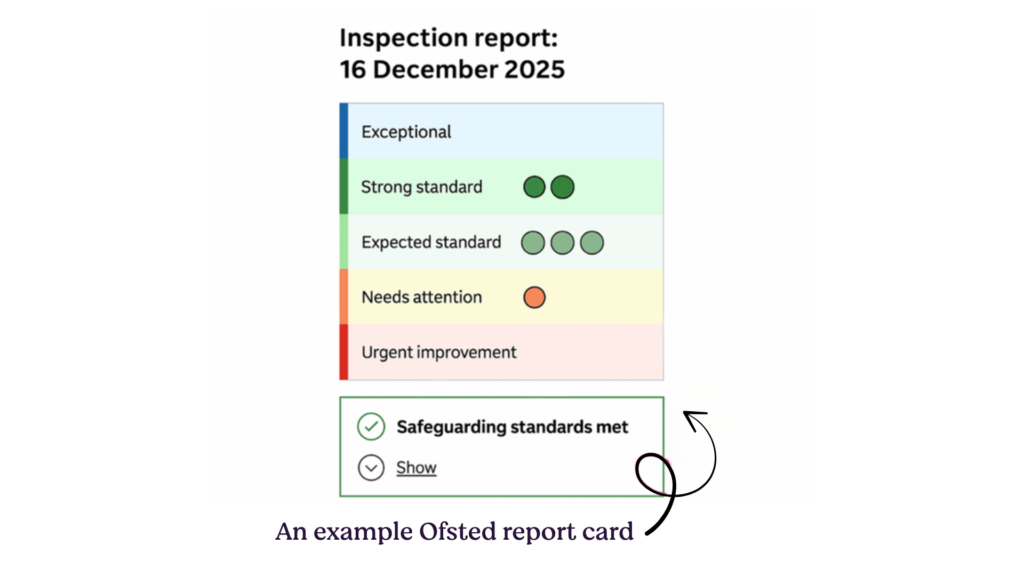
- Results: shared through the new Ofsted Report Card, replacing single-word grades
The new Ofsted process for nurseries in 2026
Many stages of the early years Ofsted inspection process will feel familiar to nursery managers. One of the main changes is the approach. Inspections are now designed to be more collaborative, with inspectors working alongside leaders to build a true picture of everyday practice.
What to expect before your nursery inspection
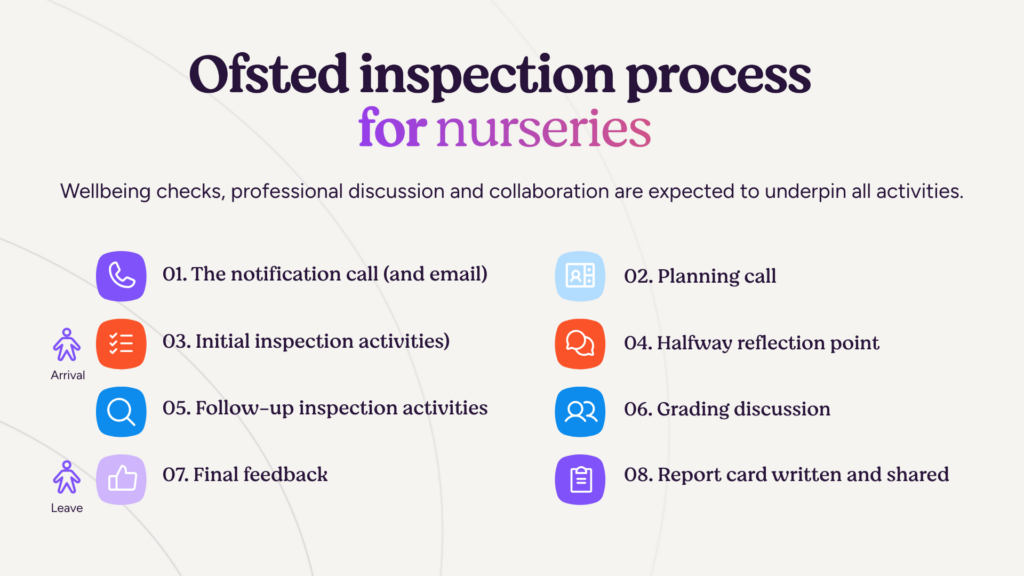
Before the day of your inspection starts, there are three key stages:
- The notification call
- The post-notification email
- The planning call
Most nurseries are notified before 10 a.m. on the working day before the inspection, unless it’s an unannounced visit.

Notification call from Ofsted
The notification call is your first contact with the inspector. It’s a straightforward, professional conversation to confirm key details and set the tone for the inspection.
During the call, the inspector will:
- Speak to the manager or the most senior member of staff available
- Confirm that an inspection is taking place, explaining the type and length of the visit
- Check contact details and any relevant setting information
- Ask about potential conflicts of interest or specific concerns
- Arrange a time for the second call later that day, known as the planning call
Post-call notification email
Soon after the first call, the manager or nominated individual will receive a follow-up email from Ofsted. This confirms the inspection details and outlines the information and documents the inspector will need you to prepare.
The email includes:
- Ofsted’s privacy notice and how to raise concerns during the inspection
- A reminder of your duty to inform parents about the upcoming visit
- Links to the inspection framework, Operating Guide and Early Years Inspection Toolkit
- Publicly available data about your local area for context
- A request to confirm who is responsible for your welfare
You’ll also be asked to share key facts about your nursery:
- The age range and number of children on roll
- How many five-year-olds attend
- Operating times
- Number of staff and their qualifications
- Number and age of children receiving additional funding
- Number of children with SEND
Planning call with Ofsted
The second call, held later the same day, is your chance to talk in more depth about your setting. It usually takes place over video (or phone if needed), lasts around 30 minutes, and cannot be recorded, though you can take notes.
If your nursery has a nominee, they can join the call along with your manager and any key leaders. Attendance will have been agreed during the first notification call.
This discussion helps inspectors understand your setting before they arrive. Ofsted describes it as an opportunity for leaders to reflect on the Early Years Inspection Toolkit, sharing what is working well and what priorities have been identified for improvement.
The call is split into three parts:
- Introductions and practical details
- Understanding your context
- Planning the timetable
Inspectors use this conversation to plan a schedule that reflects your nursery’s normal day. You can prepare by reviewing the toolkits and taking a critical look at your leadership, processes and systems.
DfE guidance makes clear that inspectors are not looking for perfection. They use a secure fit model to make judgments, focusing on consistency and evidence-based practice.
Showing that you recognise challenges and have clear plans to address them demonstrates reflective leadership. The 3 I’s remain the foundation of effective nursery leadership.

What to expect on the day of your nursery Ofsted inspection
By inspection morning, the structure of the day will already be agreed. The Ofsted timetable, arrival time and initial focus will have been confirmed during the planning call.
The inspector will complete the remaining steps of the inspection, gathering evidence, observing practice and holding professional discussions. Collaboration is a key part of the new approach.
The day should still run as normally as possible. If a leader is needed in ratio, inspectors adapt. Wellbeing is a consistent focus, and regular discussion points mean there should be no surprises.
The arrival of the Ofsted inspector
When inspectors arrive, they’ll follow the steps in Ofsted’s Operating Guide and Code of Conduct.
They will:
- Ask the nursery to display the inspection notice
- Check staff wellbeing
- Review the timetable
- Finalise children selected for case sampling
- Check safeguarding and recruitment records
- Familiarise themselves with the setting
- Review any reasonable adjustments
There are several types of Ofsted inspection activities, with strong focus on safeguarding.
Initial Ofsted inspection activities
The initial activities focus on statutory checks and safeguarding. These help inspectors understand how your nursery meets EYFS requirements.
Inspectors will prioritise:
- Checking recruitment records
- Reviewing first aid certificates and training
- Meeting the DSL
- Learning walks and observations

Follow-up Ofsted inspection activities
Once initial checks are complete, inspectors move on to follow-up activities to gather first-hand evidence and build a fuller picture.
Follow-up activities may include:
- Leadership discussions
- Shared observations
- Case sampling
- Additional activities linked to priorities
Inspectors focus particularly on:
- Disadvantaged and vulnerable children
- The difference the nursery makes
- How effectively leaders’ actions improve outcomes
- Leaders’ capacity to sustain improvement
Discussion points
Around halfway through, the inspector meets leaders to share early findings. Leaders can add context or direct inspectors to evidence.
Smaller discussion points take place throughout the day, including wellbeing check-ins and write-up breaks.
By the time final feedback is given, nothing should come as a surprise.

Talking to parents, practitioners and children
Throughout the day, inspectors will spend time chatting with practitioners and, where appropriate, with the children themselves (and their parents). These informal conversations help inspectors build a true picture of how the nursery operates day to day.
Inspectors might ask parents how well they feel informed about their child’s progress, talk to practitioners about topics like safeguarding or inclusion, and listen to children’s voices about what makes them feel happy and safe. The best way to prepare your practitioners and parents for an Ofsted inspection is through open, consistent communication.
Grading discussions and feedback
At the end of the inspection day, the inspector meets with the nursery’s leaders to share provisional outcomes and explain how each judgement was reached. This is a professional conversation rather than a surprise announcement, as key findings should already have been discussed throughout the day.
The nursery manager and nominated individual (if applicable) usually attend, along with any senior leaders directly involved in the inspection.
The final feedback session isn’t mandatory and may be combined with the grading discussion if everyone agrees on the provisional outcomes and evidence. During this meeting, the inspector summarises the evidence for each evaluation area and confirms whether the setting has met the safeguarding standard.
Leaders can clarify points if needed, but formal challenges aren’t made at this stage. The focus is on transparency and shared understanding before the inspector leaves.
The Ofsted Report Card
After the visit, the inspector writes up their findings, which are checked through Ofsted’s moderation process to make sure the judgements are fair and consistent. The final Ofsted Report Card will then be sent to the nursery within 18 working days of the inspection.
The nursery has five working days from receiving the report card to respond if there are any minor or major concerns. Once the final report card has been sent to the nursery, parents can be officially informed.
How Ovivio helps nurseries with a smooth Ofsted inspection
A big part of inspection readiness is showing clear, consistent evidence. From online medical forms, to parent communication and EYFS tracking, Ovivio is the award-winning nursery management software trusted to help your inspection run smoothly from start to finish.
By streamlining information and showing the impact of leadership choices, Ovivio gives nursery managers confidence that all of the important data, details and information can be easily accessed and pulled together ready for a smooth Ofsted inspection.