


















Every team member needs total clarity on ratios and how to apply them in your setting.
Particularly now that new versions of the EYFS statutory framework and the early years qualification requirement standards have clarified exactly how staff-to-child ratios should be applied.
In this article, we share the latest EYFS ratio requirements and what you’ll need to consider as a nursery manager when planning your staff rotas.
Accurate information you can rely on
This article is written by Louise Jackson, our EYFS content expert and a qualified teacher who specialises in creating accurate, helpful content for early years and childcare providers.
We know you need up-to-date, trustworthy information on important aspects of nursery management, like ratio compliance.
That’s why we’ve unpicked the two documents that set out ratio requirements and who can be counted in nursery ratios:
- The EYFS Statutory Framework (September 2026), which sets out staffing and ratio requirements for group and school-based settings
- The Early Years Qualifications Requirements and Standards (September 2026), which sets out what counts as a recognised qualification
2026 EYFS ratios at a glance
| Age group | Minimum ratio |
Qualified staff conditions* |
| Under 2 years old | 1:3 | At least one Level 3** with suitable under-2s experience
At least half of all staff hold Level 2 At least half of all staff are trained in baby care |
| 2 years old | 1:5 | At least one Level 3** with suitable under-2s experience
At least half of all staff hold Level 2 |
| 3-4 years old
(with a Level 6) |
1:13 | If working directly with a Level 6 qualified staff member (QTS, EYPS, EYTS)
At least one other Level 3** |
| 3-4 years old (without a Level 6) | 1:8 | At least one Level 3**
At least half of all staff hold Level 2 |
*These qualified staff conditions apply to the whole setting, not for each room in the nursery. We explain more below.
** Level 3 or have completed the Experience-Based Route (EBR) approval
Other statutory requirements that sit alongside ratios
EYFS ratios are only one part of what the EYFS framework requires. Regardless of how many staff you have available, every setting must also meet these requirements:
- Children must be adequately supervised at all times, including while eating
- Staff who obtained their Level 2 or Level 3 qualification on or after the 30th of June 2016 must hold a current Paediatric First Aid (PFA) qualification to be counted in ratio
- At least one PFA-certified person must always be on the premises when children are present, and must accompany children on outings
- A named Designated Safeguarding Lead must be in place
- Staff must be trained to recognise and respond to safeguarding concerns
Challenges with working out EYFS ratios
Is it 1:3 per room, or per setting?
It’s easy to read a ratio like 1:3 and apply it room by room, working out whether each room has enough staff on its own. But the updated September 2026 EYFS framework confirmed ratio requirements apply to the total number of staff available to work directly with children across the whole provision, not each room in isolation.
How are breaks and staff absences covered?
As the ratio applies across the whole setting, staff can move between rooms during the day, cover time to write up observations, or support mixed-age activities.
Ofsted said this in their take on EYFS ratios during inspections:
‘We may only focus on ratio requirements if there are concerns for the children in your care. We will not be constantly carrying out headcounts when we’re inspecting. Our focus is on what it is like to be a child in your care. EYFS ratio example in practice’
EYFS ratios in practice: An example
Let’s take a fictional setting with 18 children under 2, spread across two rooms. The ratio means you need 6 staff in total for that age band (18 divided by 3), not 3 staff independently meeting every condition in each room.
Once you know you need 6 staff for that age band, the qualification conditions apply across all 6:
- At least 1 of the 6 must hold Level 3 (or Experience-Based Route approval), with suitable under-2s experience
- At least half of the remaining 5 must hold Level 2, so at least 3
- At least half of all 6 must have baby-specific training, so at least 3
This means a Level 3-qualified member of staff can move between the two rooms throughout the day, or float between them, as long as the total staff count and qualification mix across the whole under-2s cohort meet these conditions.
Let’s look at who can be counted in your nursery ratio.
Who counts in early years ratios?
Ratio and qualifications are set out in two different documents (we mentioned these at the beginning), it helps to know which document does what:
- The Early Years Qualifications Requirements and Standardstells you what’s needed for a member of staff to be recognised at Level 2, Level 3 or Level 6, including which qualifications are approved and what English and maths requirements apply
- The EYFS Statutory Framework then tells you what providers must deliver for quality early years provision using that staff, bringing staffing, qualification requirements and ratio together into one set of expectations
A few other groups can also count towards ratio, under specific conditions:
- Students and apprentices aged 17 or over, and long-term volunteers and apprentices aged 16 or over, can be counted at the level below their level of study, but only where the provider is satisfied they’re suitable, competent and responsible, and they hold a valid Paediatric First Aid qualification
- Staff can also be counted at Level 3 through the Experience-Based Route rather than a formal qualification, though no more than half of the Level 3 staff at any one premises can rely on this route
How nursery managers meet needs rather than just ratio
Staff-to-child ratios exist so every child can achieve, belong and thrive, which takes more than a compliant figure on your staff rota.
Ofsted looks for evidence that your strategic staffing supports children’s learning and development day-to-day, drawn from how your rota and ratio tracking work in practice.
Supervision during cover, breaks and busy moments
Being ratio-compliant doesn’t guarantee that every room is well supervised at every moment.
If several staff members are on break, covering another room, or writing up observations at the same time, a room can be left thinly staffed even when the setting’s overall ratio is technically met.
Planning cover and staggering breaks in advance keeps supervision consistent.
Supporting children with SEND
Some children need more focused adult support to access the same learning opportunities, which can mean staffing above the statutory minimum even when the numbers on paper are compliant.
This is a judgement you’ll make based on individual need, it might be as a short-term intervention or as part of a long-term inclusion plan.
Outings and higher-risk activities
Trips, active play, and other higher-risk activities often call for more adults than an indoor session does. Room leaders and managers are expected to make that assessment themselves based on the specific risks involved.
Summary: EYFS ratios from September 2026
- The numerical ratios themselves are unchanged: 1:3 for under 2s, 1:5 for 2-year-olds, and 1:8 or 1:13 for 3 and 4-year-olds depending on qualified staff presence
- Ratios are explicitly assessed across the whole setting, not room by room in isolation (looking at quality of provision, not headcounts)
- Staff qualification levels are set by the Early Years Qualifications Requirements and Standards, while the EYFS Framework governs how they’re applied to ratio
- Students, apprentices and volunteers can count in ratio at the level below their study, subject to suitability checks and a valid Paediatric First Aid qualification
- Safeguarding and paediatric first aid requirements apply alongside ratio, not instead of it
- Meeting the minimum ratio doesn’t remove the manager’s responsibility to assess whether staffing is truly enough for the children in their care that day
How Ovivio helps with EYFS ratio tracking and compliance
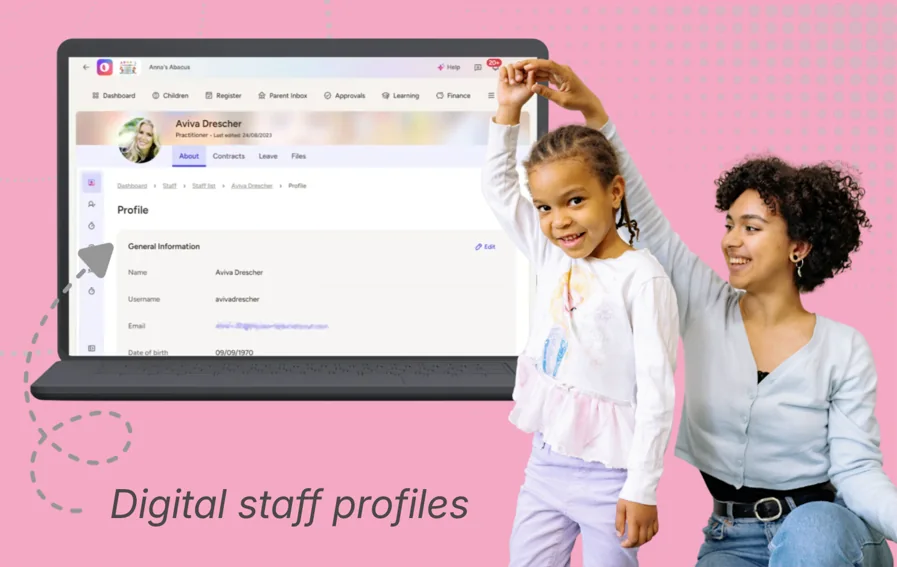
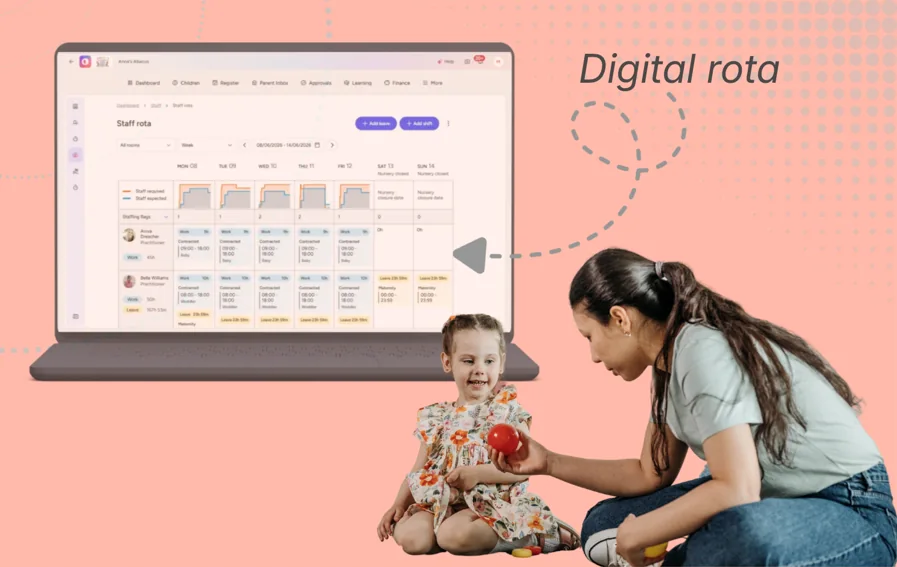
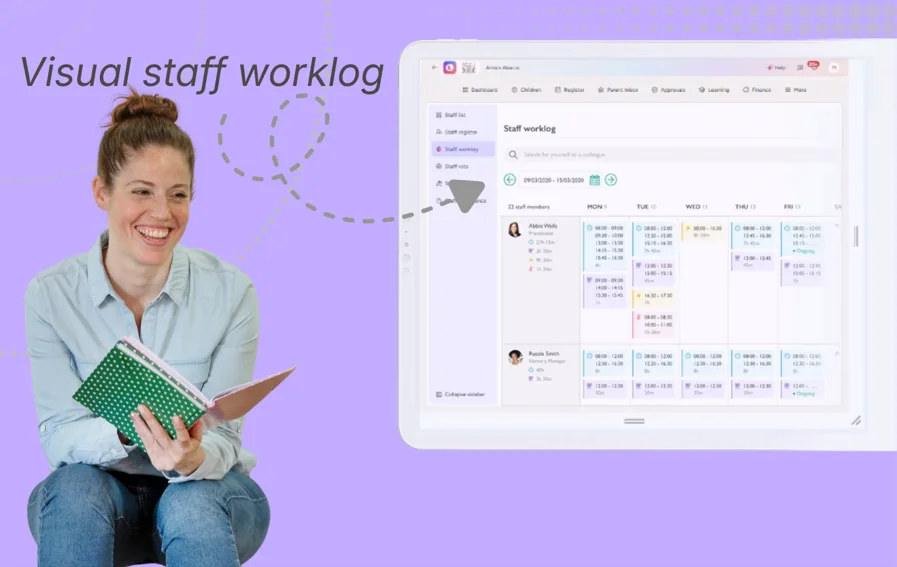
Staying on top of ratios across your nursery means having clear visibility of who’s working where and when.
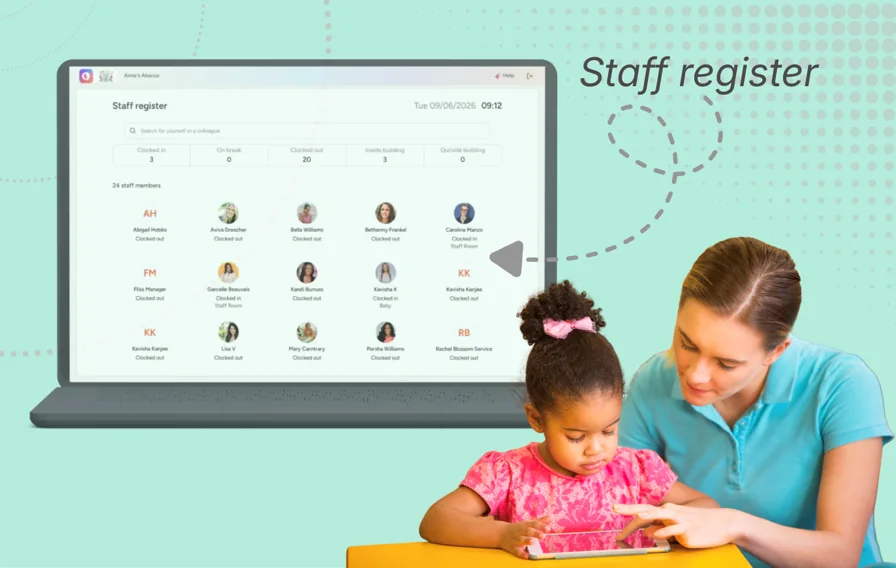
Ovivio brings staff and child attendance together in one place so that managers can see their real-time staffing picture across every room and age group.
Making it simple to plan cover, evidence your staffing decisions for Ofsted, and step in early if more supervision is needed.
Thousands of nursery managers already use Ovivio to help run their settings effectively, from staffing and attendance through to tracking children’s learning and progress.
You can see the full range of features available to Ovivio-supported nurseries here.
Book an Ovivio demo: