








Observations are part of daily nursery life, but did you know there are 2 styles of observation, 3 purpose categories, and 11 types you can use in early years?
In this article, we share the toolkit for nursery observations, using trusted frameworks and pedagogical theory to group the 11 common types of EYFS observation into 3 easy-to-remember categories, so you can choose the right one for whatever you’re trying to capture.
The layers of EYFS observations
EYFS observations have a purpose, they play an important role in the planning cycle. Done well, observations share information, include the practitioner’s interpretation and offer insight into what that child needs next.
It’s easy to think of observations as just snapshots of a child’s nursery day. But observations are a key part of ensuring children’s needs are met and demonstrating the quality of your nursery provision.
The two main styles of observation
Birth to 5 Matters frames observation through its Observation, Assessment and Planning (OAP) cycle, built on Bronfenbrenner’s Ecological Systems Theory, which splits how we observe into two styles:
- In action: observing in the middle of play, as it happens
- From a distance: stepping back to watch how a child leads themselves
The three purpose categories of EYFS observations
To build on the 2 styles mentioned in Birth to 5 Matters, we’ve further grouped the types of observation you’ll commonly use in your nursery into 3 purpose categories.
These categories focus on the purpose behind the observation: What are you trying to capture, and why?
- Moment-in-time (capturing something specific as it happens, quick, focused, and light on admin)
- Pattern-spotting (capturing the frequency or change over several instances, useful when one moment isn’t the whole story)
- Story and connection (building a bigger picture: a child’s development arc, or their place within the group)
The 11 types of EYFS observations
We’ll unpick what the 11 types of observations look like in practice in just a moment, sharing when they’re the best choice for observation types (and when they’re not).
Here are the commonly seen types of EYFS observation, you’ll be familiar with most of these:
- Narrative or anecdotal observation
- Running record
- Jottings
- Photographic or video evidence
- Time sampling
- Event sampling
- Checklists
- Child tracker or movement record
- Target child observation
- Learning stories
- Sociograms
Four ‘Moment-in-time’ observations
Reminder: These capture something specific as it happens, quick, focused, and light on admin.
- Narrative or anecdotal observation: a short, written account of what you saw or heard, written in the moment or straight after.
Good for capturing spontaneous, unplanned moments of interest or achievement.
Downside: quality depends entirely on the writer’s eye, two practitioners can watch the same moment and write very different accounts.
Example: “During free play, Amara built a tower with eight blocks, counting each one aloud, and reached for a ninth before it toppled.”
- Running record: similar to narrative, but written in real-time, present tense, as detailed as possible while it unfolds.
Good for capturing sequence and process, how a child gets somewhere, not just where they end up.
Downside: time-consuming, and near impossible to do while also actively supporting a room full of children.
- Jottings: a few quick words scribbled on a sticky note or logged on a phone or tablet in seconds.
Good for capturing volume without pulling you out of ratio.
Downside: too brief on its own, useful only as raw material for a fuller picture later and relies on memory.
- Photographic or video evidence: an image or clip paired with a short caption or annotated on the picture itself.
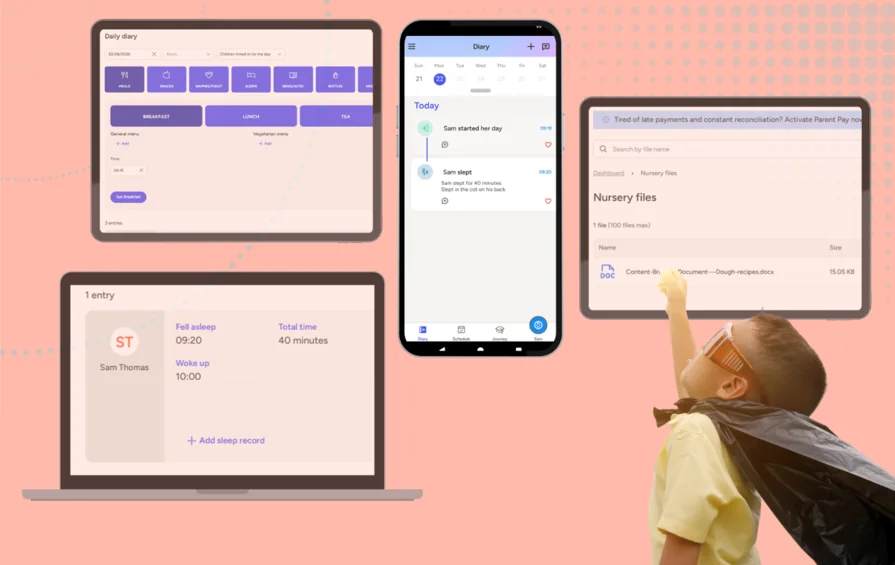
Good for capturing something words struggle with, a physical skill, an expression, a piece of work. Logging these straight onto a tablet or iPad, as nursery software like Ovivio allows, keeps you present with the child rather than stepping away to write up later.
Downside: a photo without context tells you very little on its own.
Four ‘Pattern-spotting’ observations
Reminder: These capture frequency or change over several instances, useful when one moment isn’t the whole story.
- Time sampling: observing a child at set intervals, say every five minutes, and noting what’s happening each time.
Good for spotting patterns in engagement or self- regulation across a session.
Downside: needs consistency and minimal distraction to do properly (which is unlikely in a busy nursery setting). Time sampling observations can easily be de-prioritised when the room gets busy.
Example: noting what a child is doing at 9:00, 9:05, and 9:10 reveals whether their attention holds or drifts across a planned activity.
- Event sampling: focusing on one specific behaviour, avoidance, sharing, asking for help, and logging every time it happens, along with what happened just before it.
Good for understanding triggers and the frequency of a particular behaviour, or for getting insight into children’s attitudes to learning, an area currently focused on in nursery inspections.
Downside: only useful once you already know what you’re looking for.
Example: logging that a child asks to leave group time every time it follows outdoor play might point to a need for a calmer transition, pinpointing friction in the daily routine.
- Checklists: a list of skills or milestones, ticked off as observed.
Good for a fast, structured snapshot against known developmental markers.
Downside: easy to slip into tick-box territory if it becomes the only method used, the EYFS framework’s own warning against excessive paperwork applies here.
- Child tracker or movement record: a simple map of where a child goes and what they choose across a session.
Good for understanding a child’s preferences and how they use the environment.
Downside: says little about depth of learning, only about movement and choice.
Three ‘Story and connection’ methods
Reminder: These build a bigger picture: a child’s development arc, or their place within the group.
- Target Child Observation: a structured, timed method developed by Sylva, Roy and Painter in 1980. One child is followed for a set period, coded at regular intervals against categories like activity and social grouping.
Good for data-led insight into a child’s experience of the setting.
Downside: resource-heavy, it needs a dedicated observer, which most ratios can’t spare for long.
- Learning stories: a narrative, strengths-based account of a meaningful moment, developed by Margaret Carr for New Zealand’s Te Whāriki curriculum and used widely in the UK.
Good for celebrating a child’s dispositions, self-regulation competence and identity as a learner, not just their skills.
Downside: takes longer to write well than a quick note, and quality drops if rushed.
Example: rather than “child is curious,” a learning story might read: “I watched you follow the snail’s trail across the path today, waiting patiently to see where it would lead.”
- Sociograms: a visual map of who a child plays with and how the group’s social connections shift.
Good for spotting a child who’s becoming isolated, or a friendship group forming.
Downside: only tells you about the social picture, nothing about learning itself.
Where Ofsted’s focus on disadvantaged and vulnerable children fits in
Inspectors pay particular attention to the experiences of disadvantaged children, those with SEND, and children known to children’s social care.
For these children, a single snapshot rarely proves impact, inspectors want to see a learning journey, evidence that shows real progress over time, not just in one isolated activity.
That makes the story and pattern methods particularly valuable for your most vulnerable group specifically. A target child observation or a sequence of time samples, repeated over weeks, builds the kind of evidenced trajectory that shows whether support is working, whether a child’s engagement is lengthening, their vocabulary widening, their confidence in the group growing.
A single narrative note won’t do that on its own, however well written, since it can’t show change, only a moment.
What helps you record well, whatever method you choose
A few things consistently help you to record high-quality observations:
- Nursery software that lets you log in the moment, not after
- Regular training so staff get the most from your nursery software
- Quality CPD planned and time set aside to review observations together as a team
- An honest workplace culture where staff can flag that a method isn’t collecting the most valuable data in the most time-efficient way
Where AI fits into EYFS observations
Ofsted has been clear that it doesn’t inspect specific AI tools, but it does consider how they’re used and the impact on outcomes.
That’s a useful frame for thinking about tools like Bloom, Ovivio’s AI writing assistant, which helps turn a quick jotting into a fuller narrative observation faster, without writing the observation itself. You still decide what to notice and what it means, and the tool helps get it logged in a child’s Online Learning Journal.
Used well, that kind of support could make time-heavy observation types like running records and learning stories more usable day-to-day. It won’t replace the professional judgement behind choosing a target child observation over a checklist. Still, it can make the writing-up half of the job faster, whichever method you’ve chosen.
Want more articles like this straight to your inbox? Sign up to the Ovivio blog, and we’ll send you practical articles like this one to help you become the best practitioner possible.
Sign up to our newsletter for more great content like this!