



















You plan your SEND and inclusion provision around your current children’s needs, and you should. But planning only from what you see inside your setting means meeting needs reactively, often after barriers to learning have already appeared.
National data highlights wider patterns of unmet learning and development needs among children across England. Exceptional settings understand this wider picture and plan for it, designing early years provision that addresses widespread underdevelopment while supporting the unique needs of their current cohorts.
In this article, we share the data you need to know about SEND in early years. It equips you with the national trends in SEND and inclusion needs that our youngest learners experience, and gives you the confidence to explain why your inclusion offer is designed the way it is.
How this article is written
This article draws on four key sources:
- The Department for Education’s Special educational needs in England statistics
- The Survey of Childcare and Early Years Providers (SCEYP)
- A Department for Education research report on early years SEND provision
- The 2025 Kindred² School Readiness Survey
Most statutory SEND data is collected through the school census, which starts at age five, so there’s a gap in published research on SEND in early years. This article closes that gap as far as the evidence allows, pairing national SEND statistics with school readiness surveys that show unmet needs and barriers to learning at the point children join school.
This article is written by Louise Jackson, our expert early years content writer at Ovivio. She uses her background in teaching and school improvement to create accurate, trusted content nursery managers can rely on.
What the data tells us about SEND in the early years
Before we dig into the statistics and figures for SEND in early years, we’ll clarify what the term ‘SEND’ is covering.
For this article, SEND covers more than ‘just’ diagnosed or formally identified needs. We also include shorter-term, unmet needs that, left unaddressed, could compound into a larger barrier or a SEND need later.
How to use this information
The strongest nursery managers design a universal inclusion offer that is structured enough to work consistently and flexible enough to bend around each child. This makes inclusive practice a predictable outcome instead of something left to chance.
That means looking beyond your own four walls. Managers and early years SENCOs need to hold two pictures in mind at once:
- The specific needs of the children in front of them
- The national and local trends that show widespread barriers to learning and development
The data in this article is a good starting point for evaluating how strategically your SEND and inclusion provision is designed. To use it:
- Share it with your team to build a common understanding
- Look for the common patterns in SEND need and barriers to learning
- Evaluate how deliberately your curriculum and wider provision address these barriers before they surface as a problem
This gives your decisions strategic weight when Ofsted inspects how inclusive your nursery is.

The sources behind this data
Special educational needs in England (DfE)
Published every June, this is the main statutory release on SEN prevalence in schools, built from the January school census. The school census only starts at age five, so it can’t count nursery children directly. It does show which needs are most commonly recorded as children move through school, which is a useful guide for planning in the early years.
Survey of Childcare and Early Years Providers (SCEYP)
An annual DfE survey of early years providers, SCEYP is the main regularly published source measuring SEND in early years for children aged 0 to 4. Providers report whether formal support is in place for children with SEND, including children staff believe may have SEND but haven’t yet been formally identified.
Early years provision for children with SEND and living in deprived areas
This Department for Education research report on SEND in early years analyses 2023 SCEYP data alongside qualitative interviews with 22 providers, focused specifically on how deprivation and SEND provision intersect.
Kindred² School Readiness Survey
An annual industry survey of parents and primary school staff about children starting Reception. It isn’t government data, but it shows the SEND needs and barriers to learning that primary staff see in children arriving from the early years.

From the DfE SEND statistics
Overall, 6% of pupils in England have an EHC plan and a further 14.8% receive SEN Support. The categories of need may change under the proposed SEND reforms, but these figures are a useful benchmark for the proportion of children with SEND in your nursery.
The school census records each pupil’s primary type of need. Among children with an EHC plan (age 5+), the two most common are:
- Autistic spectrum disorder: 33.5%
- Speech, language and communication needs: 22.1%
Among children on SEN Support, the most common needs are:
- Speech, language and communication needs: 25.7%
- Social, emotional and mental health needs: 24.8%
- Moderate learning difficulty: 13.8%
From the DfE early years SEND research report
The DfE’s November 2024 report analysed the 2023 SCEYP alongside interviews with 22 providers. It confirms what we already know, and what was spoken about at the recent Labour Party Conference, that SEND isn’t spread evenly across settings.
- Area makes a difference. 67% of providers in the most deprived areas cared for at least one child with SEND, compared with 53% in the least deprived areas.
- Some settings carry a higher load. Every maintained nursery school had at least one child with SEND, and 52% had more than a fifth of their children with SEND.
- Providers say needs are becoming more complex. Interviewees described more children with SEND since the pandemic, and 49% of group-based providers supported a child with an EHC plan.
From the 2025 Survey of Childcare and Early Years Providers
The SCEYP doesn’t break SEND down by type of need as the DfE statistics do. It asks providers whether each child has been identified, or is believed by staff, to have SEND, and whether or not that’s formally confirmed.
| EYFS setting type | Children with SEND | Settings caring for at least one child with SEND |
|---|---|---|
| School-based (nursery classes and maintained nursery schools) |
14% | 84% |
| Group-based (private and voluntary nurseries and pre-schools) |
11% | 90% |
| Childminders | 4% | 23% |
Data from the 2025 Survey of Childcare and Early Years Providers
Explaining what the figures mean
The two columns measure different things:
Children with SEND: the estimated share of children on a setting’s books who have SEND. Providers include children with and without formal support, and children staff think may have SEND but haven’t yet been formally identified.
Settings caring for at least one child with SEND: the share of settings with one or more of these children on their books.
Put together, 90% of group-based settings care for at least one child with SEND, and an estimated 11% of their children have SEND.
From Kindred² school readiness survey
Kindred²’s survey isn’t about SEND specifically, but it adds to the bigger picture.
The share of pupils on SEN Support builds up through the school years, peaking at age 10. That means the barriers staff see in Reception can be needs that haven’t been formally identified yet.
In 2025, parents and primary school staff were asked about children’s readiness for Reception learning.
Staff said they spend most of their time supporting their class with:
- Emotional regulation (65%)
- Social skills and interaction (64%)
- Communication and language (63%)
Parents and staff also linked readiness to SEND directly:
9% of parents said their child has a diagnosis of SEND and 21% strongly suspected SEND needs
39% of primary school staff cited identified or suspected SEND as a major reason for lack of readiness.

A summary of the unmet needs your children are likely to experience
Here’s what the data on SEND in early years points to, and what your universal inclusion offer should be ready for:
Speech, language and communication
Speech, language and communication is the most common primary need on SEN Support and the second on EHC plans. Prioritising high-quality communication and language games will benefit every child in your setting.
Social and emotional regulation
Social, emotional and mental health needs are the second most common primary need on SEN Support, and 65% of primary school staff spend most of their time supporting emotional regulation.
Social interaction and play
64% of primary school staff spend most of their time on social skills and interaction, and 74% say children who struggle to play or share have a moderate or major impact on class progress.
Listening and following simple instructions
82% of primary school staff say this has a moderate or major impact on class progress, it prevents children from being school-ready.
Independence and self-care
70% of primary school staff say children who aren’t toilet trained have a moderate or major impact on class progress, and 61% say the same for dressing independently.
Autism-related needs
The most common primary need on EHC plans is autism, so making sure your nursery is autism-friendly is essential.

What to do next
You’ll now have more understanding of the national picture of SEND in early years and barriers to learning that children experience.
Ofsted’s focus on quality leadership and governance means inspectors want to see strategic decisions and their impact on children.
Use what you’ve learned in this article to check how deliberately each of these is designed:
Your universal offer: Which of the needs above does everyday practice already support, and where are the gaps?
Your inclusion strategy and planning: Does the way you design inclusive provision reference the national picture as well as the children on roll today?
Your CPD plans: Does your nursery CPD plan cover speech, language and communication and emotional regulation?
Your EYFS tracking: Could you use EYFS tracking to spot a child falling behind in communication or self-care early enough to act?
Your communication with parents: Do families know how your setting supports these areas of need? And do you share quality information with your parents?
Your resources: Do your spaces, visual supports and equipment reflect the needs you’re likely to meet?
None of this replaces knowing each child and having secure attachments and relationships. It gives you the wider context of what the data says about EYFS SEND needs, and equips you with the evidence to explain your strategic decisions.
How Ovivio helps you put this into practice
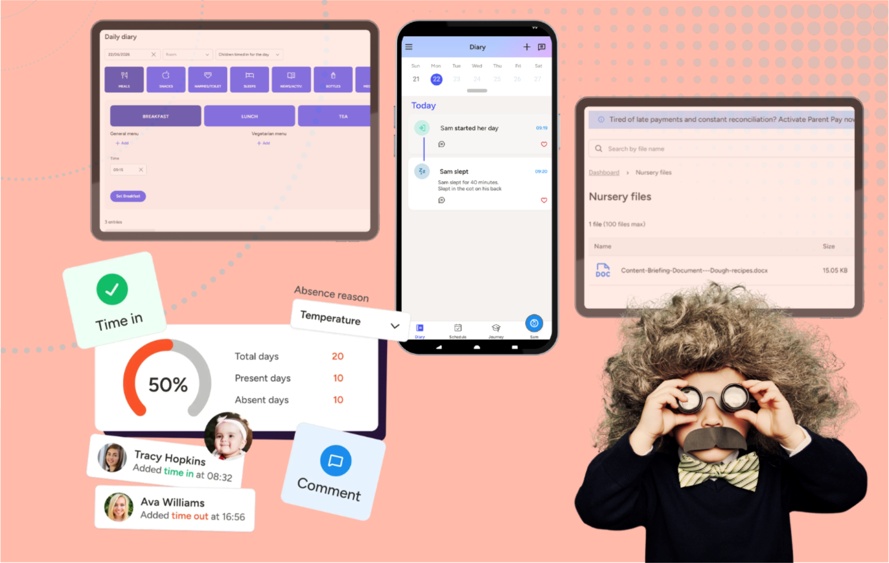
Ovivio is nursery management software that brings the day-to-day running of your nursery into one place. Managers use it for invoicing and funding, staff planning, attendance, enquiries and business reporting, alongside child development tracking and our award-winning Parent App.
For inclusion, nursery managers love how child development combines with progress visibility.
You record observations against the framework you use, and Cohort Tracking compares children across areas of learning to show who may need help. Ovivio Pathways, a SEND framework designed with SENCO experts, sits alongside Children’s Diaries, which share each child’s progress with their family.
Book a demo with the Ovivio team and see cohort tracking, online observations and SEND pathways in action.
Book an Ovivio demo: