









Inclusive practice shows how consistently your setting identifies and meets every child’s unmet needs. Those unmet needs are the barriers getting in the way of a child’s learning, development and wellbeing, and inclusive practice is how you remove them. In this blog, we define inclusive practice in the early years, outline the expectations for your nursery, and show how the 3C’s can help improve provision.
This article is useful for
Nursery owners, managers and practitioners who are looking for clarity on what inclusive practice means in EYFS and want to know what Ofsted, the DfE and the SEND Code of Practice expect when it comes to inclusive practice.
The definition of inclusive practice in early years
Inclusive practice isn’t just seen in one moment. It’s the whole process that lets a child fully participate in their own learning, and it includes four main parts:
- Knowing there’s an unmet need
- Understanding what that need is
- Acting on what you’ve seen and understood
- Checking whether it’s reduced the barrier and met the need
Most of this happens dozens of times a day, often without consciously working through the four steps. A practitioner notices a child struggling to settle, works out why, adjusts what they’re doing, then sees if it’s worked, all inside a few minutes.
The same process also exists formally, you’ll know it as the Graduated Approach used for SEND support: Assess, Plan, Do, Review (APDR).
Inclusive practice is consistent, considered and curious about the reasons for barriers to learning or unmet needs.

The statutory definition of inclusive practice
Four sources set out early years inclusion in law and inspection practice:
The 2026 EYFS Statutory Framework lists equality of opportunity as an overarching principle, recognising every child as unique and constantly learning.
The Equality Act 2010 places an anticipatory duty on providers, expecting you to prepare for inclusion in advance rather than reacting once a need appears.
The SEND Code of Practice 2015 sets out the Graduated Approach we’ve mentioned, and confirms that SEND support sits within ordinary nursery provision rather than apart from it.
And Ofsted’s updated Early Years Inspection Toolkit identifies that a well-run nursery has inclusion underpinning everything it does, from how the environment is set up to how staff talk to families at drop-off.
Inspectors are looking at the systems you’ve designed to prioritise inclusion in your nursery. They examine the journey of inclusion across your whole setting over time, not just from a single strong example or one child’s success story.
SEND support is just one part of inclusion
Inclusion means removing anything that stops a child from fully accessing the EYFS: the early learning goals and the seven areas of learning. It applies to every child, whether or not they have an identified SEND need. SEND support is one part of inclusion, a legally defined process for children with an identified need or disability. But many of your most vulnerable children have barriers to accessing the same learning and development opportunities, without an identified SEND need.
- A child with English as an additional language
- A child affected by disadvantage*
- A child experiencing Adverse Childhood Experiences (ACEs)
*Ofsted’s inclusion evaluation area focuses on four groups: children eligible for the Early Years Pupil Premium (EYPP), children with SEND, children known or previously known to children’s social care, and children who may face other barriers to their learning or wellbeing, including those who share a protected characteristic under the Equality Act 2010.

What does exceptional inclusive practice look like?
No two settings are the same, and therefore the way they prioritise inclusion will look different too. But there’s one thing that all quality nurseries will have in common. They’ll have designed systems to ensure inclusive practice is a predictable outcome for all children.
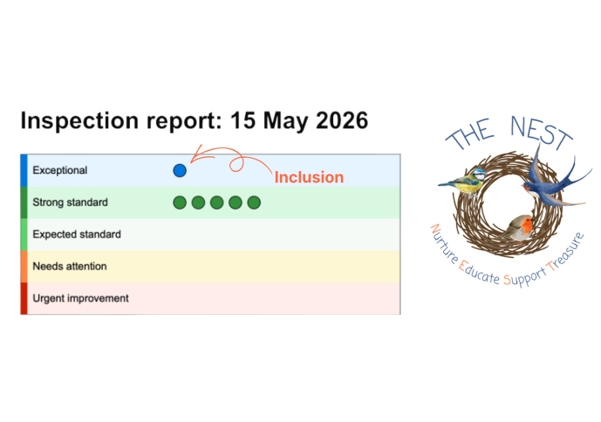
We spoke to the Co-Founders of The Pheasant Nest, Claire and James Nichols, after they received exceptional for inclusion during a recent Ofsted inspection. They had 6 key areas of strength that demonstrated just how inclusion is the priority in their childcare setting.
Although it’s useful to see how other nurseries embed best practice in their setting, and to understand how Ofsted inspects inclusion, it’s important to shape your strategy for inclusion around the needs of your children and their families.
What shapes your nursery’s inclusion strategy:
Your curriculum, environment and the way you interact with children and families should be shaped around:
- The wider national picture of SEND needs and challenges
- Your local community’s specific needs
- Your staff’s current strengths and where they’re still developing
- Your nursery’s own ethos
- The needs your children have right now
- The needs that might present as they grow
- What children are exposed to outside your nursery
- The wider picture of their health and wellbeing

The 3 C’s of effective inclusive practice
It’s essential to know the markers of what good inclusive practice looks like in the day-to-day aspects of your nursery. Using the 3C’s to help you and your team unpick whether an interaction was making the most of your agreed inclusive practice process or only partly.
- Consistency of approach
- Curiosity about the unmet need
- Considered responses
You can use these reflective questions during professional development sessions with your team for scenario-based CPD tailored to your setting.
Consistency
- Do you have systems in place to give every child the same access to opportunity?
- Does the quality of inclusive practice depend on the practitioner?
- Does the process for identifying and supporting a need follow the same structured pattern for smaller adjustments and larger provision support plans?
Curiosity
- Are relationships used as the vehicle for identifying and understanding an unmet need?
- Do practitioners respond or react to presenting behaviour?
- Are practitioners encouraged to ask for advice from other experts?
- Are incidents recorded and a larger picture of unmet need built over time rather than in isolation?
- Are family relationships nurtured and child development knowledge passed on?
Considered
- Does evidence-based research back the chosen way to support a child?
- Are both long-term skill development and short-term support interventions planned?
- Is there a gap in staff SEND knowledge and confidence?
- Are you monitoring the progress and outcomes from targeted support?

There’s one element inclusion relies on
Inclusion depends on one thing above everything else, and it’s something nurseries are uniquely placed to give: relationships.
Secure relationships between practitioners and children are the vehicle inclusion runs on. When a child feels understood, loved, and supported, they can develop with confidence, building the skills they need for successful outcomes.
Preparing for your next Ofsted inspection?
We’ve built a hub of advice and guidance for nursery managers, covering every evaluation area, best practice and nursery management non-negotiables. Find your next article:
- The Complete Guide to Nursery Management in 2026 (free downloadable)
- 8 Ofsted activities to expect during your early years inspection in 2026
- 37 early years Ofsted inclusion questions for your nursery team
- Types of EYFS observations: what each one captures, and when to use it
- EYFS Behaviour and Attitudes Interactive Quiz: 11 Non-negotiables
- Three layers of support: a practical approach to nursery staff mental health
- 6 Risk factors for poor mental health in early years children
Sign up to our newsletter for more great content like this!