


















If you’ve seen Benedict’s Law popping up in sector news since September, you might be wondering whether it changes anything for your nursery. It’s a fair question, especially as the new allergy rules were written with schools in mind.
The DfE’s allergy safety guidance isn’t statutory for nurseries and other early years providers. However, it describes itself as ‘of relevance’ to early years settings and says it should be treated as good practice.
In this article, we explain what Benedict’s Law is, whether it applies to nurseries and which EYFS safer eating and allergy requirements you must follow.
 Share it with your nursery team to avoid any mixed messages about what’s required.
How this article was written
This article was written by Louise Jackson, Ovivio’s EYFS content expert. Louise is a qualified teacher with a Masters in Inclusion who specialises in creating accurate, helpful content for early years and childcare providers.
To make sure you can rely on every detail, we’ve used government sources only:
- DfE Allergy safety in schools: statutory guidance (July 2026)
- EYFS statutory framework (September 2026)
- Supporting pupils with medical conditions at school: government consultation response (July 2026)
- DfE Stronger protections for children with allergies in school (March 2026)
- DfE Help for early years providers: Food allergies and intolerances
- Foundation Years EYFS food brought in from home: FAQs (February 2026)
What is Benedict’s Law?
Benedict’s Law is the name given to new allergy safety duties for schools in England. It’s named after Benedict Blythe, a five-year-old who lost his life to an allergic reaction at school.
His parents, Helen and Peter Blythe, spent four years campaigning for stronger protections for children with allergies. They worked with other families and the National Allergy Strategy Group, and the government says it listened to them in making these changes.
Benedict’s Law came into force in September 2026 for schools, introducing statutory allergy guidance all schools must follow.
As it stands, the requirements don’t apply to early years settings or independent schools, although the government intends to bring in allergy safety requirements for independent schools too.
Under the Children’s Wellbeing and Schools Act 2026, local authority-maintained schools, academies and pupil referral units must now have an allergy safety policy.
What the DfE’s statutory guidance asks of schools (not nurseries)
| Area | What schools are expected to do |
|---|---|
| Allergy safety policy | Have a dedicated policy, reviewed at least once a year and published online |
| Leadership | Name a senior leader as responsible for allergy safety, rather than the catering manager |
| Training | Give allergy awareness training to all staff on site, at least annually |
| Spare adrenaline | Stock ‘spare’ adrenaline auto-injectors in pairs, within five minutes of where they might be needed |
| Individual Healthcare Plans (the EYFS uses ‘allergy action plans’) | Develop plans with the child and their parents, with any allergy action plan attached |
Does Benedict’s Law apply to nurseries?
Nurseries don’t have a legal requirement to apply Benedict’s Law to the setting (but it’s good practice to).
The guidance says early years settings, along with schools that have EYFS children, should keep applying the EYFS statutory framework. For PVI nurseries and childminders, your allergy requirements still come from the EYFS Statutory Framework.
In practice, there’s a lot of overlap between the school’s guidance and what the EYFS already asks of you, so you’ll probably recognise plenty of your team’s everyday practice in it.
Why nurseries can’t stock spare adrenaline auto-injectors
Spare auto-injectors are the one place where nurseries can’t follow the schools’ lead.
Under the Human Medicines (Amendment) Regulations 2017, schools can buy ‘spare’ adrenaline auto-injectors without a prescription. The guidance is explicit that those regulations only apply to schools, which means early years settings aren’t permitted to stock spares in the same way.
When the DfE consulted on the guidance, some respondents asked for the regulations to change so early years settings could stock spares too, but the government didn’t commit to it.
For now, the focus stays on each child’s own prescribed medication, managed through your medicines policy and their allergy action plan.
Your EYFS safer eating and allergy requirements
Your duties for managing food allergies in early years settings come from the EYFS safer eating section.
We’ve given the paragraph numbers from the group and school-based framework, with the childminder version in brackets so that you can check the wording for yourself.
Before a child starts: 3.65 (3.64)
Before a child officially joins your nursery, you must gather information about any dietary requirements, preferences, food allergies, intolerances and special health requirements. That information then needs to reach every member of staff who prepares or handles food.
There’s a mealtime duty too. At every meal and snack, it must be clear who’s responsible for checking the food meets each child’s needs.
Allergy action plans: 3.66 (3.65)
The EYFS expects ongoing conversations with parents and, where appropriate, health professionals to co-develop allergy action plans for any known allergies and intolerances.
Plans need to be kept up to date and shared with all staff. For a template, the framework points you to the British Society for Allergy and Clinical Immunology allergy action plan.
Staff knowledge and paediatric first aid: 3.64 and 3.66 (3.63 and 3.65)
Every member of staff must know the symptoms and treatments for allergies and anaphylaxis, along with the difference between an allergy and an intolerance. They should also know that a child can develop an allergy at any point, with the introduction of solid foods being a particular time to watch.
Whenever children are eating, a member of staff with a current paediatric first aid certificate should be in the room. The full course includes helping a baby or child having an allergic reaction or anaphylactic shock.
Supervision at mealtimes: 3.70 (3.69)
Children must always be within sight and hearing of staff while they eat. Where possible, the group and school-based framework asks staff to sit facing them. It’s a simple habit that helps you spot choking, stop food being shared and notice an unexpected allergic reaction quickly.
Food from home and nut bans
Settings shouldn’t usually ban allergens such as nuts, according to the Foundation Years FAQs on food brought in from home. A ban is only appropriate once every other control measure has been exhausted.
Parents can still bring in food for birthdays and celebrations, but it should be checked for allergens and handled safely. Your food and nutrition policy is a good place to explain to parents how you manage food from home.
Benedict’s Law good practice for early years settings
If you’d like to go a step further than the EYFS Framework, three parts of Benedict’s Law translate well to nursery life.
An allergy safety policy for your nursery
The guidance suggests early years settings have a dedicated allergy safety policy, as schools do. Sitting alongside your medicines policy, it gives parents and new starters a clear picture of how you manage allergies day to day. It’s also a useful addition to your Ofsted inspection documents checklist.
 To mirror what schools now do, name a nursery leader as your allergy lead and review the policy every year.
Allergy awareness training for your team
There’s no official ‘Benedict’s Law’ course, but the guidance does expect regular allergy awareness training for all staff.
How often should staff refresh their allergy knowledge? The EYFS doesn’t say. Schools, on the other hand, are now expected to train all staff at least once a year, with the guidance pointing out that first aid training alone isn’t enough.
The free food allergy training from the Food Standards Agency, linked from DfE’s Help for early years providers, can be a good place to start.
Learning from incidents and near misses
If your nursery provides meals or snacks, it counts as a food business, so you must record and review allergen incidents and near misses. The guidance encourages a ‘no blame’ approach focused on learning.
Even a quick team chat after a near miss can show you whether a policy or a child’s allergy action plan needs updating.
How Ovivio supports allergy safety in your nursery
Keeping allergy information accurate, and in front of the right people at the right time, can be one of the trickiest parts of safer eating.
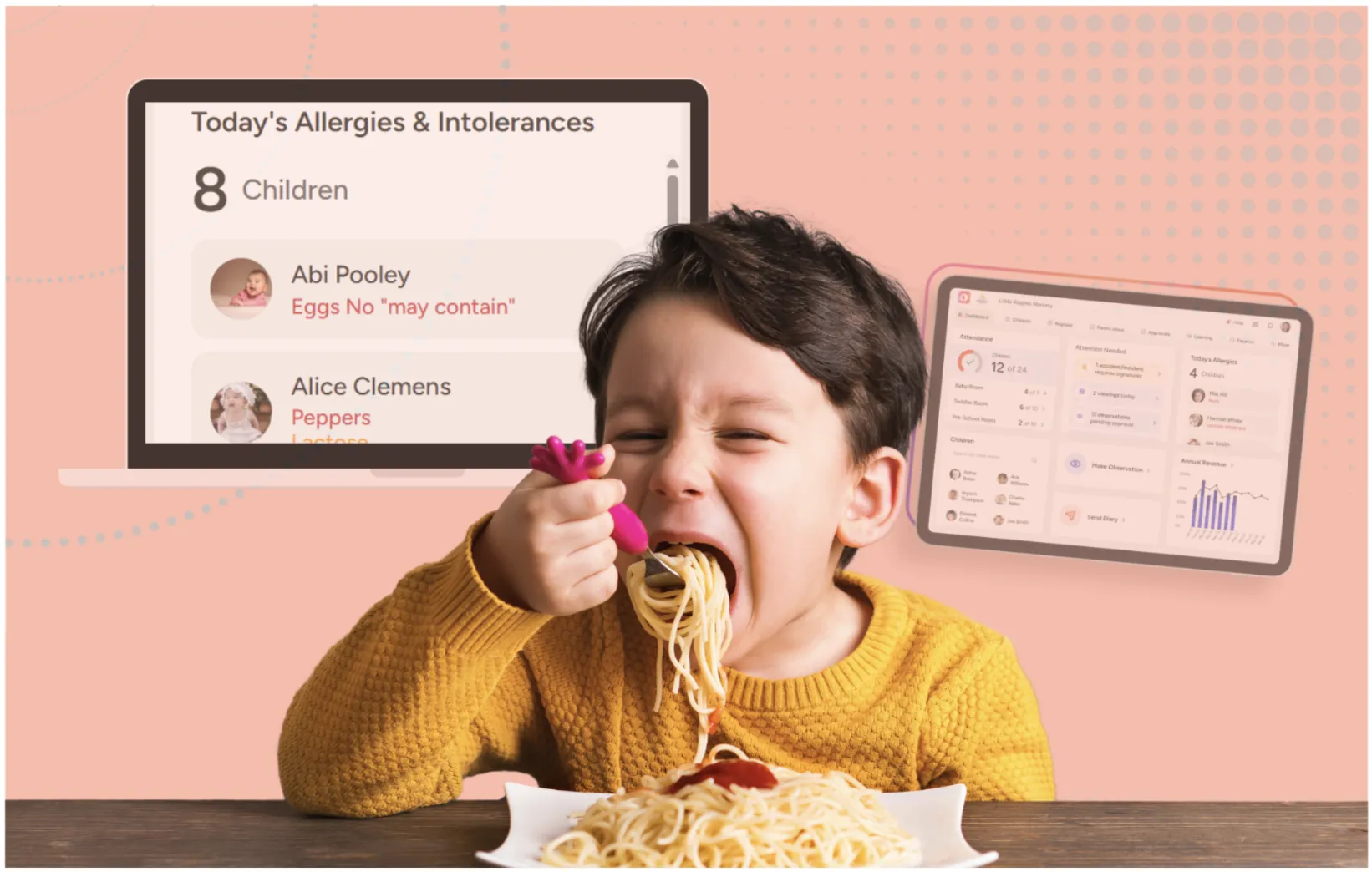
In Ovivio, each child’s allergies and medical requirements sit on their profile. Staff also get showing which children are due in and which allergies to be mindful of.
The Child Diary lets you build menus around each child’s dietary requirements. Alongside it, Medication Forms help you record medicines in line with your policy, while the award-winning Parent App keeps you and families in touch about any changes to a child’s allergies
Sign up to the Ovivio newsletter for the latest EYFS updates, or book a demo to see how Ovivio could work in your setting.
Sign up to our newsletter for more great content like this!